

UnitedHealth Group, a stalwart Dow Jones component and important part of the healthcare sector, is trading 50% below recent all-time highs due to operational challenges (they pulled guidance), regulatory scrutiny (the DOJ is probing potential Medicare Advantage fraud) and leadership changes. This report reviews the business, growth, capital allocation, valuation and risks, and then concludes with my strong opinion on investing.
About:
UnitedHealth Group operates through two primary segments: UnitedHealthcare and Optum. UnitedHealthcare provides health insurance plans (i.e. employer-sponsored, Medicare Advantage and Medicaid plans). Optum is the healthcare services arm, and includes Optum Health (provider services), Optum Rx (pharmacy benefits), and Optum Insight (data analytics and technology). In 2024, UNH generated ~$400 billion in revenue, with UnitedHealthcare and Optum both contributing significantly (roughly equally after accounting for intersegment eliminations). Optum’s services enhance UnitedHealthcare’s efficiency, thereby creating a unique competitive advantage (moat) within the healthcare ecosystem.
Market Share:
UnitedHealth Group is the largest health insurer in the U.S. by market share, covering approximately 15% of the insured population. It holds a leading position in the Medicare Advantage market with over 8 million members enrolled (out of roughly 30 million total Americans in Medicare Advantage plans). Optum serves 103 million consumers through its pharmacy and health services, and Optum Rx processes over 1.4 billion prescriptions annually. UNH’s scale and diversified operations give it a dominant position, although competitors including CVS Health (Aetna) and Cigna are challenging its market leadership.
Growth Slowed by Rising Costs:
Revenue and earnings per share (EPS) have both been growing at a healthy clip for UnitedHealth Group, although the company has recently suspended its full-year guidance due to elevated Medicare Advantage costs.
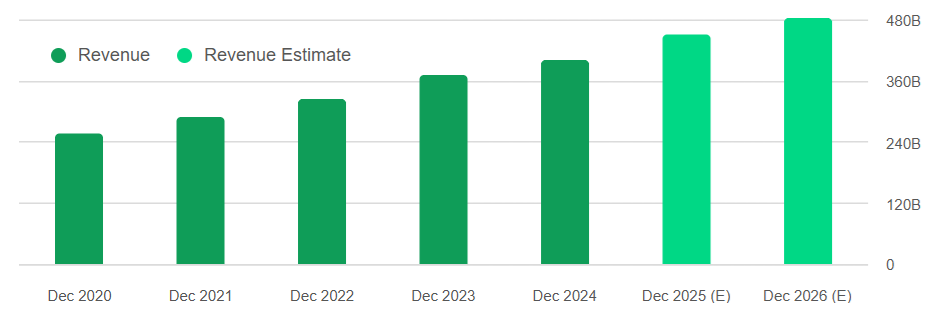
Specifically, increased care utilization in 2024 (particularly among seniors for outpatient procedures) resulted in costs exceeding expectations and heightened uncertainty.
And in Q1 2025, Medicare Advantage activity was 2x the expected rate (significantly above the already elevated levels seen in 2024), and the company attributes this to ongoing Medicare funding reductions, changes to its member mix, and minimal 2024 beneficiary engagement by plans exiting the market.
For example:
Regulatory changes: The Centers for Medicare & Medicaid Services (CMS) implemented a 2024 rate notice that insurers, including UnitedHealth, criticized as a net revenue cut.
UnitedHealthcare added 404,000 Medicare Advantage members for 2025, reaching over 9.8 million enrollees; and new members, particularly those from exiting plans, had unexpectedly high care needs due to undiagnosed conditions or minimal prior engagement.
The Inflation Reduction Act includes costly changes. For instance, it has removed the Part D coverage gap, effective in 2025, and a $2,000 out-of-pocket cap for prescription drugs which has led to higher deductibles or premiums in some plans.
These changes aim to reduce member costs over the long term, but they have caused some significant cost pain in the short term. So even though UNH has delivered healthy growth historically (e.g. revenue and earnings per share (EPS) have grown at a compound annual rate (CAGR) of 10-12% over the past decade), it has suspended its full-year guidance for 2025 due to the elevated medical costs in Medicare Advantage (and other risks, to be discussed late). However, the company does expect to return to its 13-16% long-term growth target by 2026.
Valuation:
From a valuation standpoint, UNH trades at historically low valuation multiples (as you can see in the table below) due to near-term uncertainties.
Specifically, at a price of only 12.2x earnings (i.e. P/E ratio), UNH shares are an absolute steal if you believe the cost challenges and other risks (to be discussed momentarily) are temporary. However, the market clearly hates uncertainty and lower profits (even if it is, arguably, only temporary).
Dividends and Capital Allocation:
UnitedHealth Group pays a quarterly dividend of $2.10, which equates to a 2.9% annual dividend yield. The payout ratio (see below) of 35.18% is a bit high by historical standards, but perhaps not if you believe the elevated cost pain is largely temporary. The company also has a strong history of healthy dividend growth (16% annually over the last decade) and a large cash pile of over $32 per share (the shares have recently traded at around $300).
In recent years, UNH has also repurchased billions of dollars in shares, though expected full-year 2025 buyback figures are unavailable due to suspended guidance. The company also invests heavily in Optum’s growth, including acquisitions and technology development. Despite recent challenges, UNH’s strong cash flow (over $20 billion annually) supports its capital allocation priorities.
Risks:
Of course, UnitedHealth Group faces significant risks that have contributed to its share price decline.
DOJ Probe: One major concern is the reported Department of Justice (DOJ) criminal investigation into potential Medicare Advantage fraud, following a civil fraud probe earlier this year. The allegations focus on billing practices, which UNH denies.
Medicare Advantage Costs: The company’s Medicare Advantage business is under pressure from higher-than-expected medical costs, as mentioned earlier. Again, increased utilization by seniors and regulatory changes have put pressure on the shares
CEO Changes: CEO Andrew Witty resigned in May 2025 (citing personal reasons) and was replaced by former CEO Stephen Hemsley. Witty’s exit coincided with the suspension of 2025 guidance, thereby raising governance concerns (i.e. fear). Also, the murder of UnitedHealthcare CEO Brian Thompson in December 2024 has compounded negative sentiment. Worth mentioning, CEO Stephen Hemsley’s recent large share purchases (see below) is interpreted positively by some.
Other Risks: A historic cyberattack earlier in 2025, combined with regulatory scrutiny, potential fines, and competitive pressures (in Medicare Advantage and pharmacy benefits) all pose significant ongoing risks.
Conclusion:
From a valuation standpoint, UNH shares are particularly inexpensive, depending on your view of the heightened risks, as discussed. The risks and challenges are very real but are likely overblown (i.e. fear). This is a stalwart blue chip company (with an ecosystem moat) and an important part of the United States healthcare system and economy (it has dominant market share). I suspect the fear will subside, and the shares will eventually trade much higher.
If you are a short-term risk-averse investor, you’re probably going to want to avoid UNH here. But if you are a long-term growth-and-value contrarian, these shares are attractive. I will likely add shares in the near future.