

The Schwab US Dividend Equity ETF (SCHD) is an income investor favorite and also a frequent punching bag for many backward-looking growth investors. And despite this year’s unusually strong performance, it is currently sitting exactly in the crosshairs of the perfect macroeconomic storm ahead (including Trump’s supreme court flippancy with regard to tariffs and the fed’s great unwind which is still only just beginning). This report reviews the fund, the macro storm ahead, and three easy alpha strategies to win with SCHD.
About SCHD
With a focus on high-quality US companies that pay healthy growing dividends, SCHD is an income investor favorite. Its total assets have grown more than 2,700% over the last decade (to over $84 billion) as investors have piled in even though its total returns have significantly lagged the S&P 500.
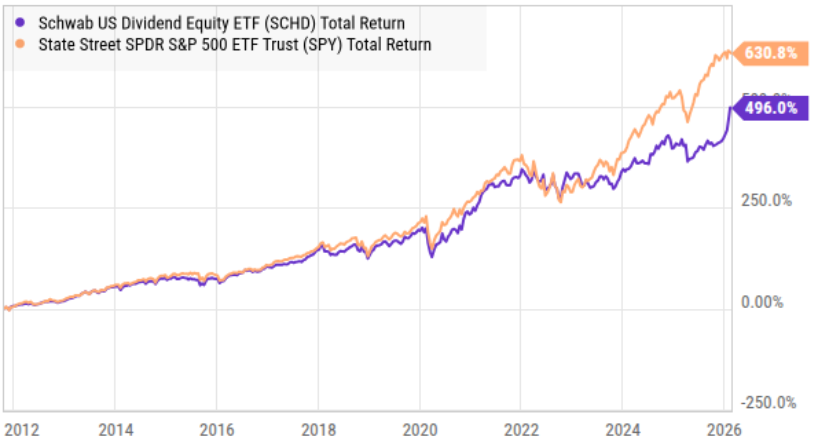
Buyers often proclaim they like SCHD’s low volatility (as compared to the S&P 500) plus the perceived safety of SCHD’s blue chip holdings (which favor value-stock industries while also underweighting the growth and technology sectors that have allowed the S&P 500 to easily outperform over the last decade plus.
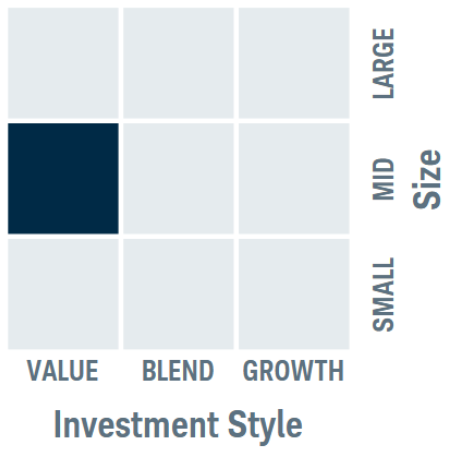
And it is exactly these factors that place SCHD directly in the crosshairs of the perfect macro storm ahead. Let me explain.
Macro Factor 1: Trump’s Supreme Court Flippancy (Tariffs and Nationalism)
Trump’s recent tariff moves (both “liberation day” in 2025 and now thumbing his nose to the Supreme Court’s ruling in February of 2026 via Section 122) have exacerbated certain stock market vulnerabilities. For example, import-heavy growth and certain large-cap stocks (big tech) are now feeling the pain of an investor rotation to value and small caps (which are more tariff-resilient). And SCHD is a strong relative beneficiary (considering its tilts toward value stocks with heavy US manufacturing and more domestic revenues:
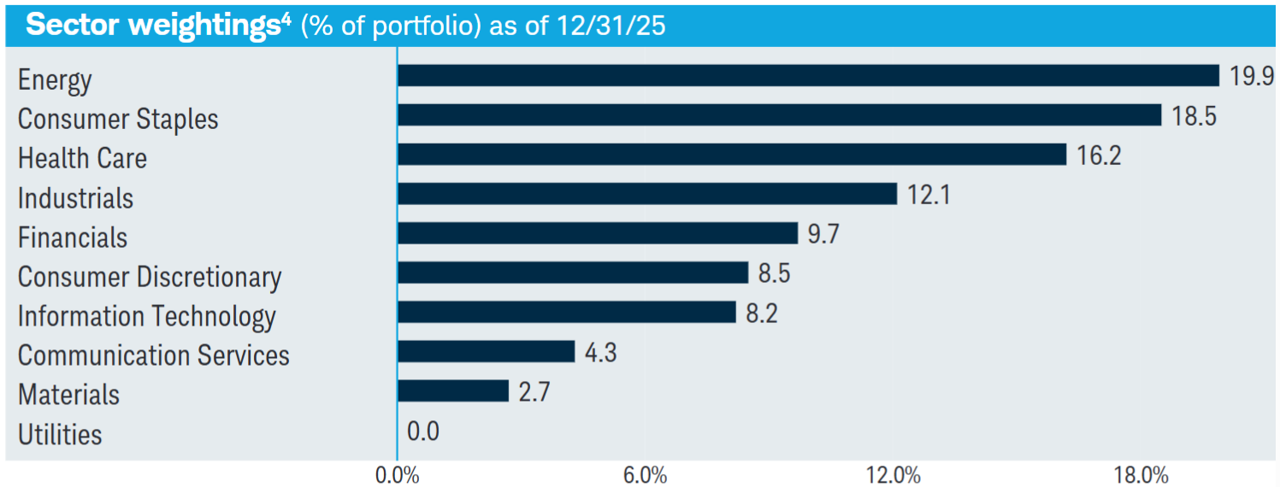
US-Manufacturing Tilt: SCHD has higher exposure to US manufacturing than the S&P 500, primarily through its allocation to the Industrials sector (which includes most manufacturing-related companies). For example, SCHD's Industrials weighting is around 11.4%, while the S&P 500's Industrials sector is only around 8.3%. Also, SCHD's focus on high-quality dividend payers often favors stable, established industrial and manufacturing firms (e.g., holdings like Lockheed Martin, Home Depot, and various machinery/transportation names) giving it a relative overweight in this area compared to the tech-heavy S&P 500.
Domestic Revenues: SCHD also has higher exposure to US (domestic) revenues in general as compared to the S&P 500. This is because SCHD consists entirely of US-listed companies (screened for consistent dividend payments and quality), which tend to derive a larger portion of their revenues from the domestic US market due to its value-oriented, defensive, and industrials-heavy tilt (e.g. sectors like consumer staples, healthcare, and utilities often have more US-centric operations). In contrast, the S&P 500 has significant international revenue exposure, historically around 40%+ driven by its heavy weighting in global tech giants like Microsoft, Apple, and Nvidia that generate substantial earnings abroad.
Macro Factor 2: The Fed’s Great Unwind is only just Beginning
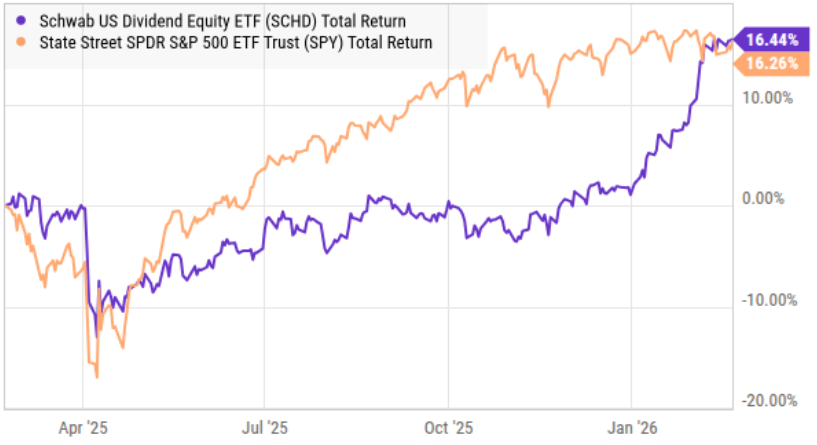
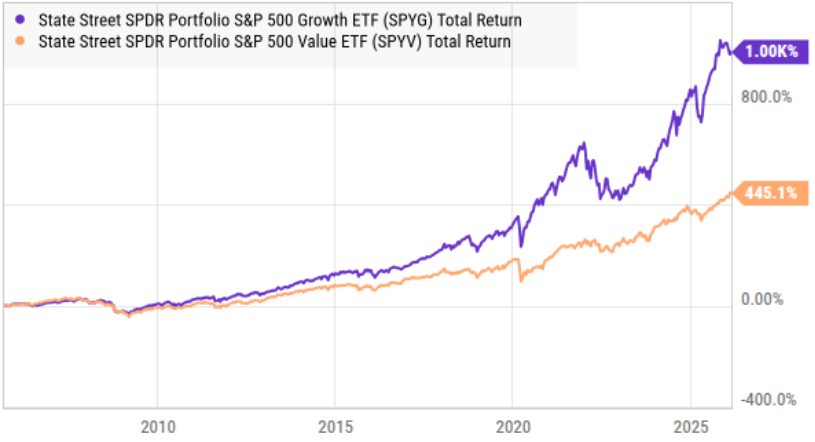
The decade-plus dominance of US growth stock performance has recently started to shift as value-oriented strategies (such SCHD) are recently the leading performers (see chart below). Big reasons for this are the fed’s balance sheet unwind and—indirectly—US dollar weakness.
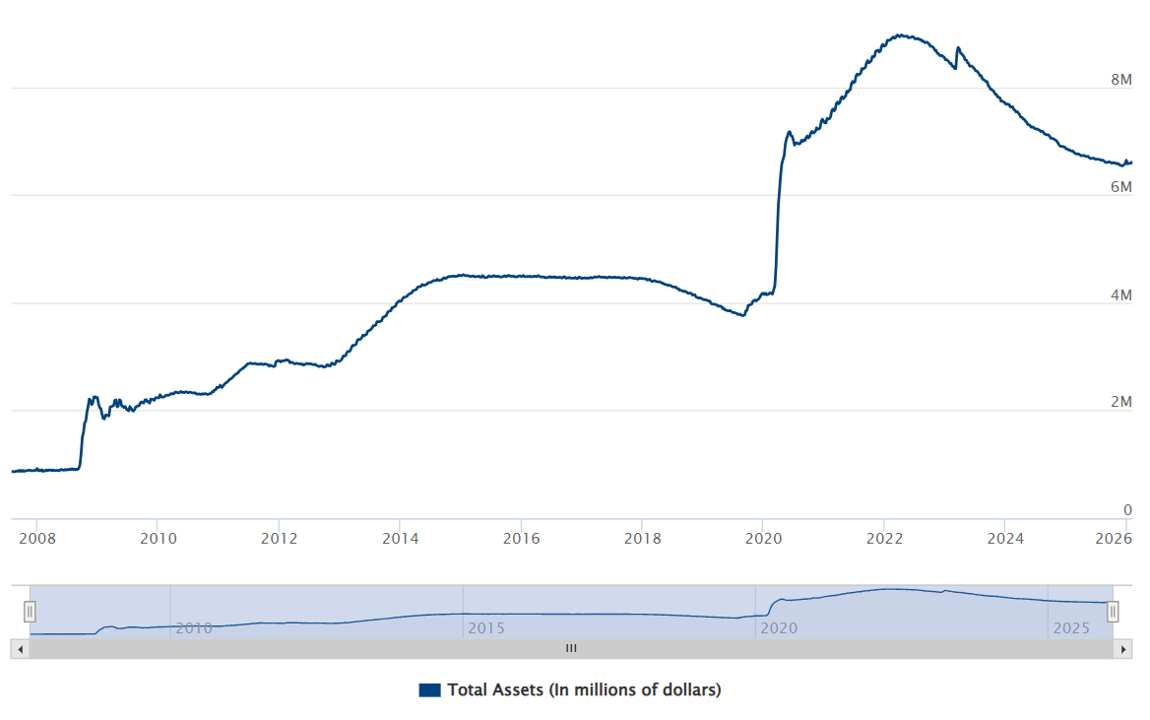
The Fed’s Balance Sheet Unwind: As you can see in the chart below, the US fed’s balance sheet is only just recently starting to shrink after a decade-plus expansion that strongly favored growth stocks and relatively punished value investors (e.g. SCHD). The balance sheet grew as part of extraordinarily stimulative monetary policies (which also included near-zero interest rates) designed to revive the economy from its near-death “Great Financial Crisis” in ‘08-’09 (and again following the covid shutdowns). Low interest rates and free money favor growth stocks, and that has been a huge factor in the dominating performance of growth stocks.
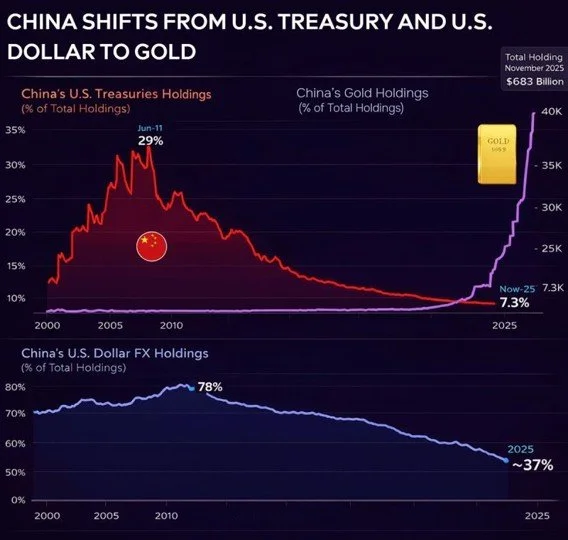
US Dollar Weakness: Although less of a direct impact on SCHD’s performance, it’s also worth mentioning growing concerns about the strength of the US dollar. Specifically, the strength of the US dollar (or lack thereof) is another reason why US-domiciled global big-tech companies are underperforming recently, and why non-US stocks have been a relative outperformer for US dollar denominated investors. More specifically, growing concerns about the dollar since the US fully ditched the gold standard, have accelerated post-GFC (and even more post covid) as both fiscal and monetary stimulus, now combined with “trade wars,” are leading investors to question the dollar’s global-reserve-currency status (the US government lost its “AAA” credit rating) and pushing them to invest in alternatives such as gold. This slow-moving but accelerating megatrend shift (with lots of noise) is another factor that should be baked into investment decisions (more on this later).
3 Easy-Alpha Strategies: To Win with SCHD
So with those two macroeconomic megatrend factors brewing in the background (i.e. Trump’s “America First” economics and the broader US government’s disregard for the integrity of the US dollar), let’s consider their short- and long-term impacts on SCHD, as well as specific investment strategies to generate alpha and win big with SCHD in particular.
Qualified Dividends: Depending on your tax bracket, and whether you own SCHD in a taxable or non-taxable account, is one of the most straightforward ways to add alpha (defined as the excess return of an investment relative to a benchmark). Especially when you consider SCHD’s total return potential (price appreciation plus growing dividends reinvested) as compared to other popular “higher yielding” investments that often pay non-qualified dividends (sometimes more appropriately described as “distributions”), especially considering they frequently destroy their own share prices just to maintain those glittery big distributions that yield chasers love. For most investors (but certainly not all), qualified dividends are often taxed at 15%—lower than their marginal tax rate. And when you combine SCHD’s focus on qualified dividends with its focus on long-term capital appreciation (also often tax at 15%—long-term capital gains tax rate for many investors and again lower than most investors marginal income tax rate), SCHD can be pretty darned attractive as compared to the un-qualified, capital destroying (often via return-of-capital-sourced distributions) sparkly high yields that often get way more attention than they’re worth. If peers are your benchmark—SCHD’s long-term alpha potential is attractive.
Owning SCHD in an IRA—Depending on your personal situation, it can make sense to own SCHD in an Individual Retirement Account (“IRA”) whereby dividends are taxed at 0% (versus often at 15% if you own it in a taxable account). Of course, there is a whole science behind whether or not to own SCHD inside or outside of an IRA (the answer depends in large part on how aggressive SCHD is relative to your other investments). But if you want to outperform your peer benchmark, owning SCHD in a tax-advantaged IRA is a quick way to add alpha (it’s called “asset location” and it can add up to 0.60% of alpha according to this popular Vanguard report).
A Quasi-Bond Substitute in your Risk Budget: A lot of investors long for the days of the early 1980’s when a US treasury bond offered a 15%+ annual yield and the US government still had its AAA credit rating. Alas, today we’re stuck with lower yields and higher risks on treasuries, while the stock market is way too volatile for many investors’ taste. But rather than allocating your investments to a traditional 60/40 strategy (i.e. 60% stocks and 40% bonds) you might consider SCHD as a quasi-bond substitute (it does yield 3.3%—almost as much as that massive Vanguard Bond strategy (BND) that lands in almost every target date fund they sell), plus SCHD has more long-term price appreciation potential. Some investors comfortably outperform a 60/40 benchmark strategy by increasing their stock allocation (perhaps to say 70%) but with SCHD—a strategy they view as more attractive than investing in the full S&P 500 which includes a massive allocation to volatile growth stocks). In this sense, SCHD can be a quasi-bond alpha-generating allocation strategy within their overall risk budget.
Risks:
Macroeconomic Sensitivity: SCHD has benefited from recent macroeconomic factors (such as Trump’s tariff impacts and the fed’s monetary policies), but just as quickly as these factors have benefited SCHD recently, they can create headwinds if the economic environment changes significantly.
Structural Underperformance vs. Growth-Oriented Investments: The index upon which SCHD is based has strict rules (10-year dividend history + quality screens like cash flow to debt and ROE requirements) systematically excludes or underweights high-growth companies that don't pay dividends or have shorter histories. This has caused notable lagging vs. the S&P 500 in growth-driven periods, especially since 2022 and in 2025. While SCHD can shine in value rotations (e.g. the strong start to 2026), it often misses big upside in tech/AI rallies. The opportunity cost of investing in SCHD has been very real.
Heavy Sector Concentration is another risk. For example, SCHD has a big overweight to energy stocks as compared to the S&P 500. And this concentration can cause the fund to underperform the market at various points in the market cycle. Also worth mentioning, SCHD has little direct exposure to real estate, as REITs for example, often don’t pay qualified dividends.
Interest Rate Sensitivity: High-dividend yield stocks often act like bond proxies whereby rising rates (or expectations thereof) can pressure valuations as investors shift to safer fixed-income alternatives. Falling rates can help, but the fund has shown varying sensitivities in past interest rate cycles.
The Bottom Line:
SCHD is up big and smoking the S&P 500 in recent months. This is a stark reversal of what happened in the 10-15 years prior as growth stocks were absolutely dominant—by a lot!
While markets are noisy, the shift towards value (such as SCHD) may be indicative of a massive long-term trend reversal and reversion to a more normal environment whereby value stocks do outperform growth (for example, that is the reality according to the 3-factor model of Nobel prize winner Eugene Fama).
And in the real-world, macroeconomics may also support a long-term run of outperformance—for value stocks (such as SCHD) over growth stocks—that is still just barely getting started.
Especially considering the perfect storm of Trump’s Supreme Court flippancy (with regards to tariffs) as well as the massive unwind of the fed’s balance sheet that is still only just starting (after years of dovish monetary policies that goosed growth and now increasingly call into question the strength of the US dollar).
And while many investors with different goals and different timeframes shout at each other about whether SCHD is a good investment, the reality is both sides often miss the easy alpha opportunities SCHD can provide, depending on your own personal investment situation and goals, of course.
At the end of the day, you have to do what is right for you. Disciplined, goal-focused, long-term investing continues to be a winning strategy.