
Once considered “blue chip” software names, the shares of Salesforce (CRM), Adobe (ADBE) and ServiceNow (NOW) are down 39%, 41% and 52%, respectively, over the last year. Meanwhile, chip stocks (those in the industry powering the AI revolution) are up 141% over the last year, as measured by the iShares Semiconductor ETF (SOXX). How much of this divergence is based on fundamentals—and how much is based on the fear narrative—the market will eventually reveal. In the meantime, here are a few reasons why you may NOT want to go “all in” on chip stocks at this point and instead consider a few contrarian software stock opportunities.
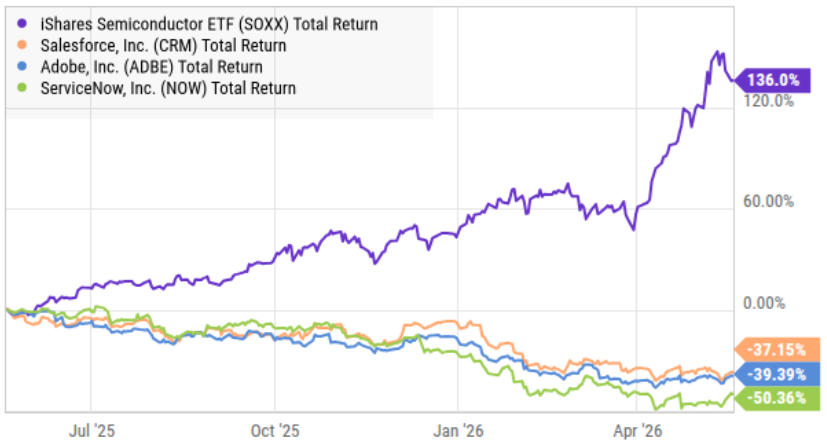
Extreme Divergence
There is also an uncomfortable AI narrative hanging over software. Investors increasingly fear that generative AI could compress margins, commoditize certain workflows or reduce the value proposition of legacy SaaS products. Whether those fears ultimately prove accurate remains uncertain, but the market has already repriced many software names as if disruption is inevitable.
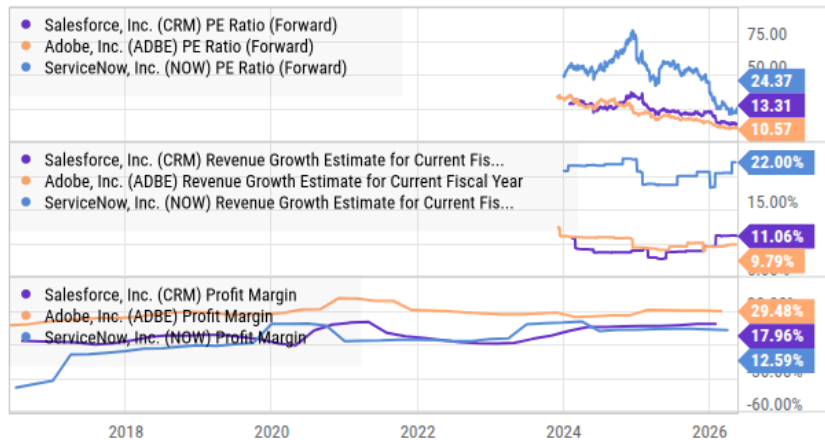
However, AI tools embedded into CRM systems, digital content platforms and IT service management products could eventually expand margins and deepen customer lock-in rather than destroy it. Companies like Salesforce, Adobe and ServiceNow are not standing still; each is aggressively integrating AI copilots and automation capabilities into their ecosystems.
On the other hand, there is real risk for semiconductor investors that expectations may now be too high. Semiconductor stocks are cyclical businesses historically—prone to boom-and-bust periods tied to capital spending.
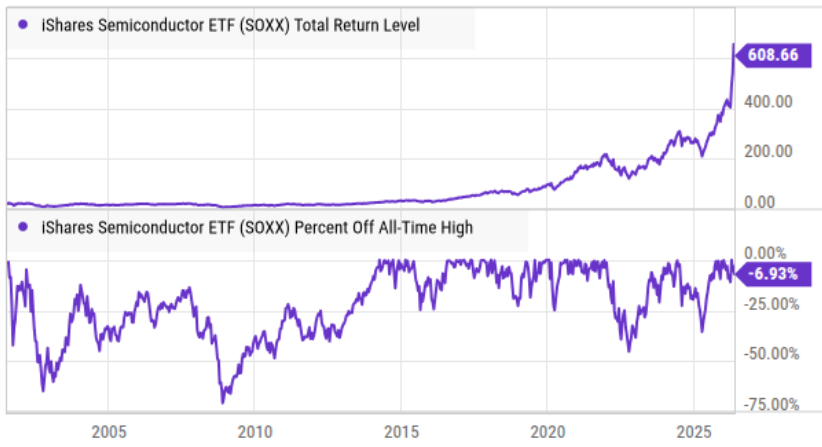
Today’s valuations increasingly assume sustained hyperscaler demand, uninterrupted AI investment and limited competitive pressure. Any moderation in AI spending growth could create meaningful downside volatility in chip stocks that have already experienced enormous multiple expansion.
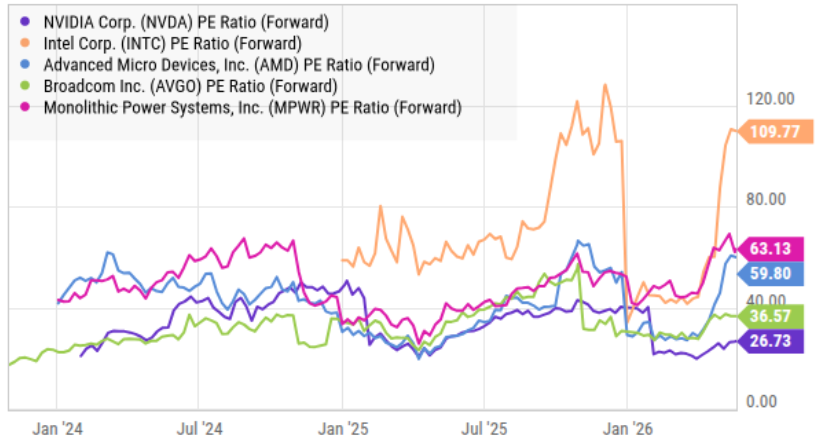
That does NOT mean investors should abandon semiconductors entirely. The secular AI trend remains real and likely durable. But it may suggest a more balanced approach going forward.
The Bottom Line
Over the last year, semiconductors have captured nearly all of the AI enthusiasm while software has absorbed much of the skepticism. For long-term investors, periods of extreme divergence often create the most compelling opportunities—not by chasing what has already worked, but by identifying quality assets that may be temporarily out of favor.