
If you are more than just an investing hobbyist, it can make a lot of sense, from time to time, to take a step back and view the market from 10,000 feet. This report reviews (and shares data) on 5 high-level market themes, and then reviews 5 specific investment opportunities within each theme. Enjoy!
Long-Term vs Short-Term
Before getting into the 5 themes, it’s worth briefly considering the market from a very high level. For perspective, you can see in the chart below the average return of the S&P 500 in each calander year going back to 1980.
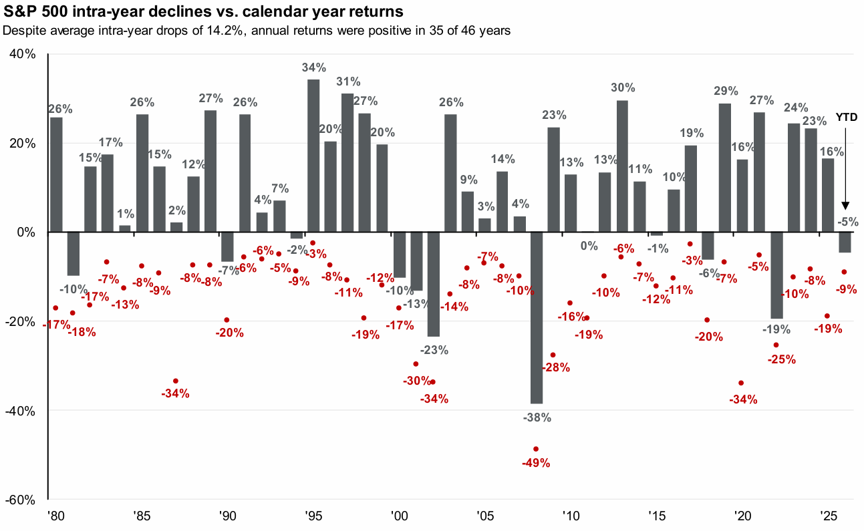
As you can see, the market has been “up” (sometimes a lot) in a lot more years than it has been down. Yet, you can also see it was down (sometimes a lot) temporarily mid-year (i.e. the red data points above).
The point is simply that volatility is normal, and if you are able to take a long-term view—the volatility becomes increasingly less relevant (and your returns have increasingly compounded and grown).
Theme 1: Exchange-Traded Funds (ETFs), Passive Investing
For starters, consider the rise of passive investing and ETFs. You can see in the chart below just how rapidly ETFs have been growing.
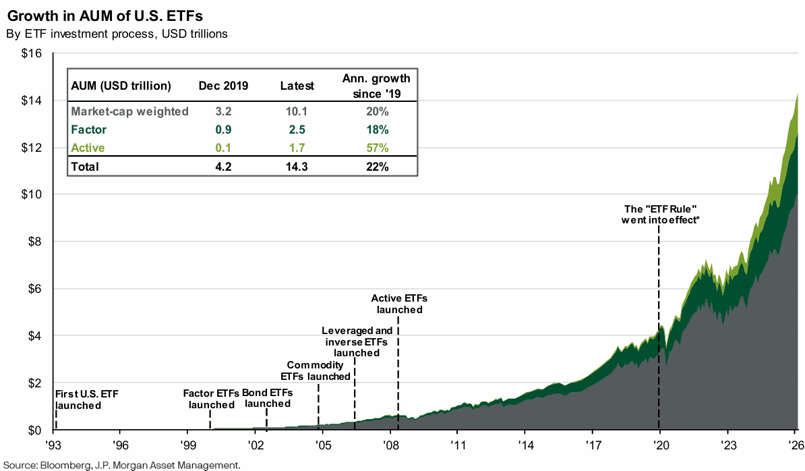
And for perspective, passive Investing (whereby you don’t pick individual stocks, but rather invest in the entire market or entire market segments) has now grown to 13% of the entire US stock market, including more than 20% of the S&P 500.
ETF Investing Can Do Quite Well
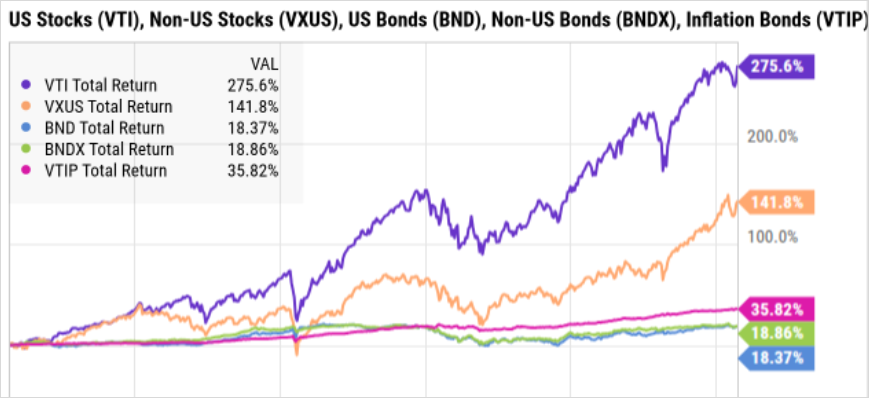
And passive ETF investing can, in fact, do quite well (relative to a lot of active investors). For example, Vanguard’s very popular “Target Date” funds invest mainly in just 5 ETFs, each representing a different major segement of the investment landscape:
VTI Stocks (US)
VXUS Stocks (Non-US)
BND Bonds (US)
BNDX Bonds (Non-US)
VTIP Inflation Protection Bonds
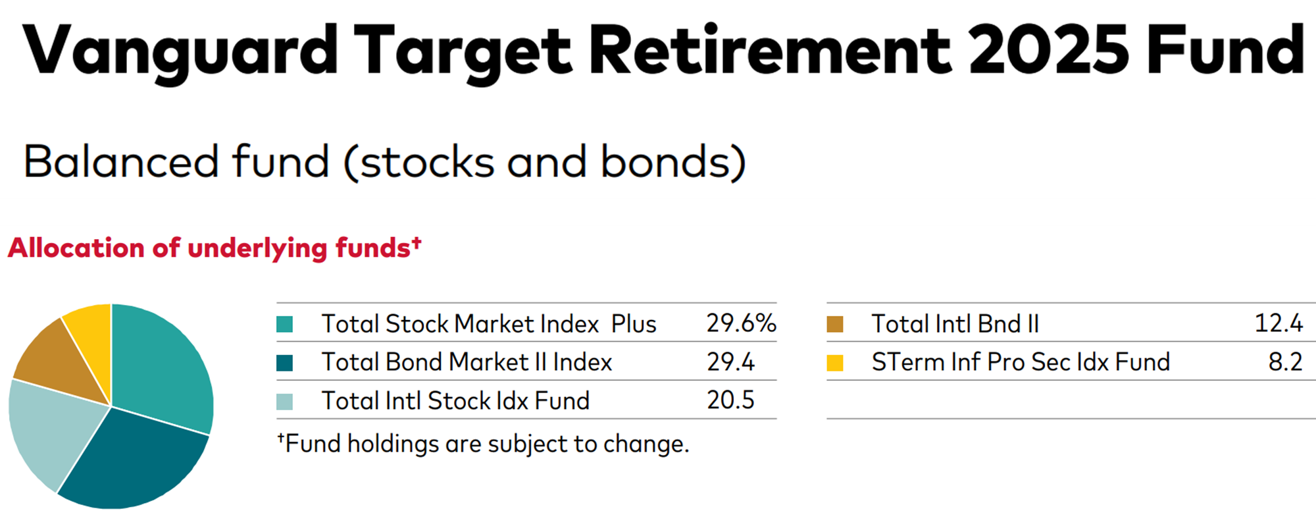
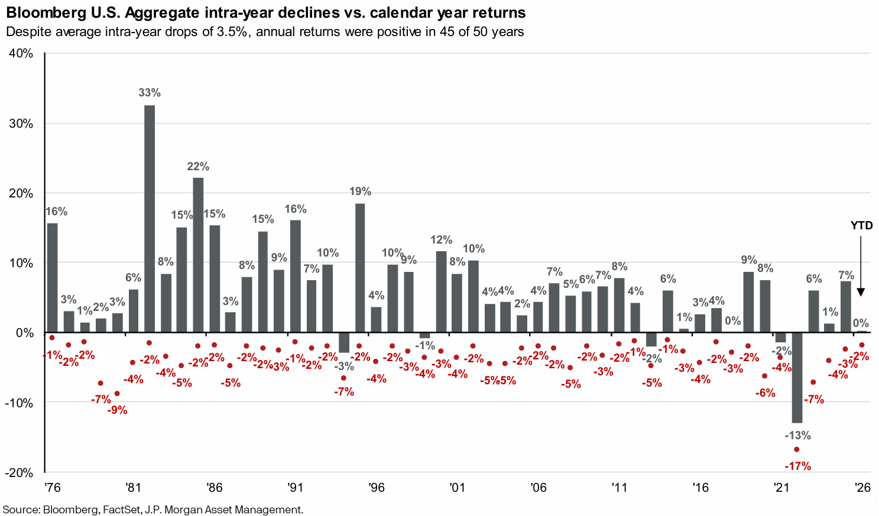
And truthfully, the Inflation-Protection sleeve that ends up in a lot of more-conservative Vanguard Target Date Funds (Vanguard just adds more of the equity sleeve for more aggressive—long-term strategies, and more bond market exposure for more conservative strategies) is a recent phenomenon (a bit of a reaction to the challenges caused by covid stimulus—massive inflation—as you can see what happened to non-inflation protected bonds in 2021-2022 (an extreme negative year for the ages, as the fed hiked rates rapidly to fight inflation—but higher rates means lower bond prices—all else equal).
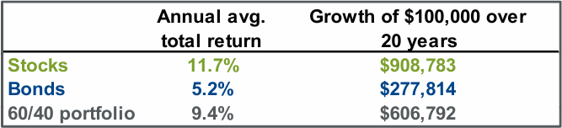
And for more perspectie, here is a look at how these 5 passive ETF sleeves have performed over the last decade (a lot can be said about the macroeconomic policies that led to this):
But let’s first switch to theme #2…
Theme 2: Artificial Intelligence (AI)
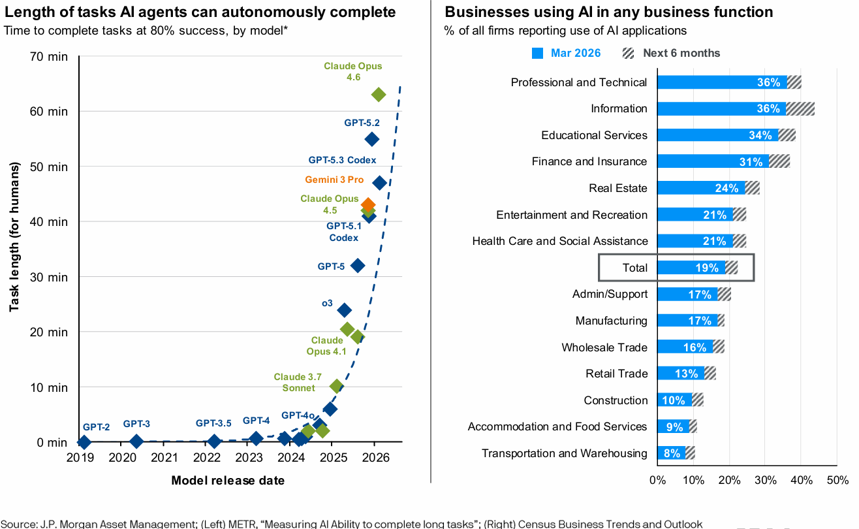
AI is growing rapidly, now impacting essentially every corner of the markets.
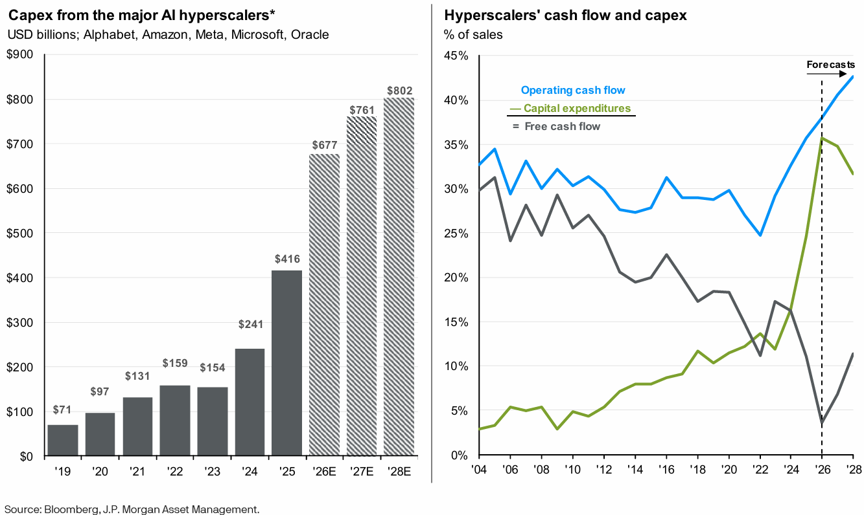
And the majority of the AI spending is coming from the so-called “hyperscalers,” such as Alphabet (GOOGL), Meta, Amazon and Microsoft.
And the leading AI stocks (such as Nvidia) have posted absolutely dominant performance relative to the benchmarket S&P 500 over the last several years, as you can see in the chart below.
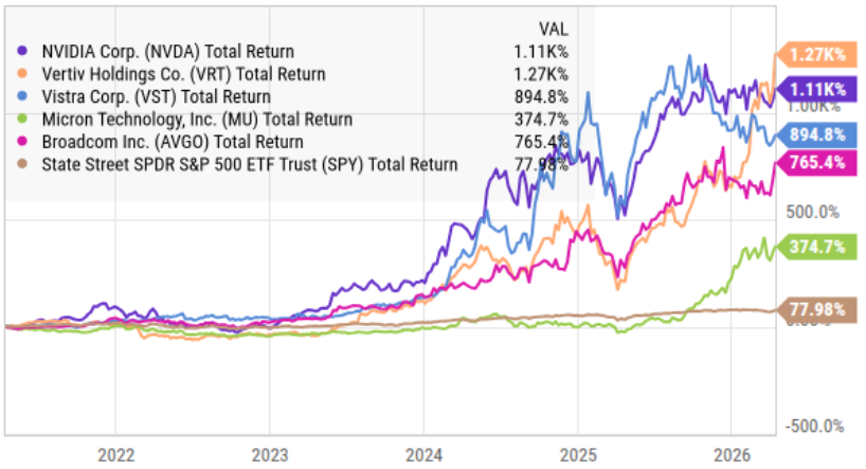
NVIDIA (NVDA): Designs the dominant GPUs and AI software stack used to train and run most modern artificial intelligence models in data centers.
Vertiv Holdings (VRT): Supplies the cooling, power, and physical infrastructure systems that keep AI data centers running reliably at scale.
Vistra Corp. (VST): Produces and sells electricity—an essential input for powering energy-intensive AI data centers.
Micron Technology (MU): Manufactures memory chips (especially HBM and DRAM) that are critical for feeding data to AI processors.
Broadcom (AVGO): Designs custom AI chips and networking components that connect and accelerate large-scale AI computing systems.
which leads us to Theme #3…
Theme 3: AI is Eating Software
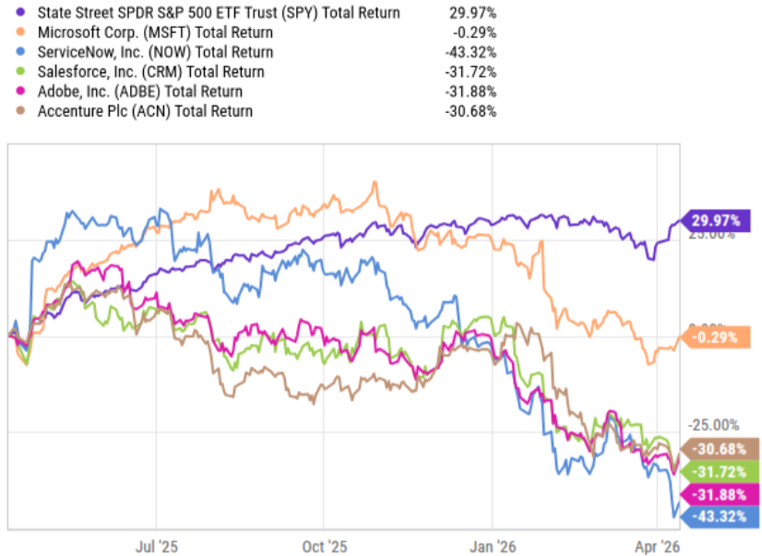
As you can see in this next chart, the performance of traditionally-dominant software-related stocks has been—well—ugly.
Yet from a financial “fundamentals” standpoint, some will argue shares of these stocks have gotten extremely inexpensive relative to their growth, while others will note this is all backward-looking data and can be misleading…
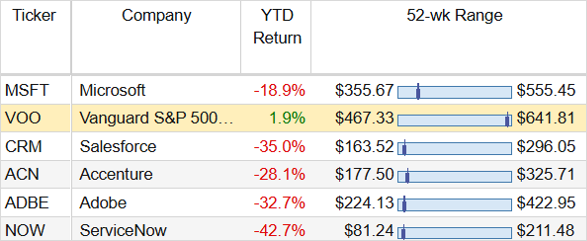
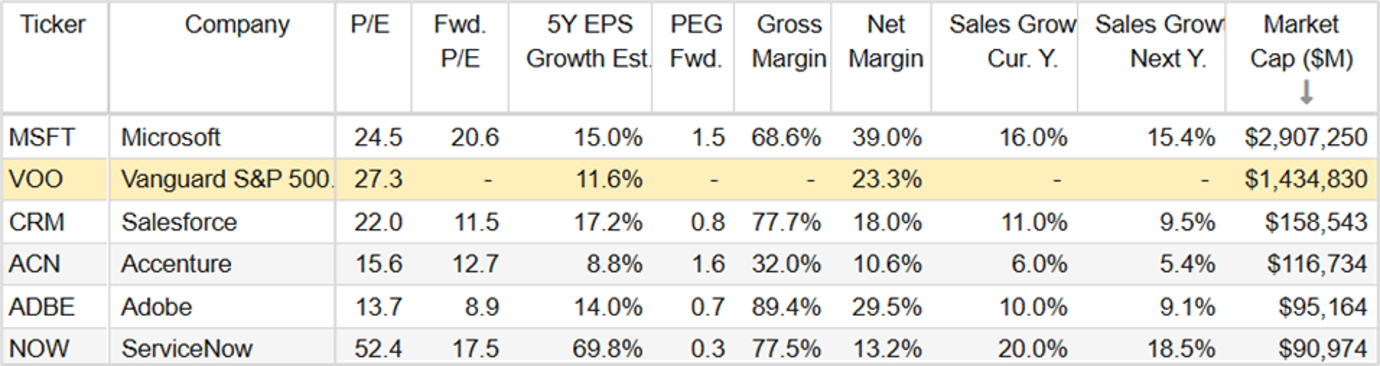
There are likely a few good/attractive contrarian opportunities in this theme #3 group, as the market has a tendency to take things a little too far at times. For example, Microsoft looks attractive here to this author.
Theme 4: Bond & Money Market Funds
But switching gears to theme #4, not all investment dollars must go to the stock market, and “bond and money-market funds” are aguably back (after years of near zero interest rates, followed by dangerous rapid interest rate hikes which caused another batch of challenges).
When you are looking for a little more stability and income, there are attractive opportunities to be had:
Schwab Money Market Fund (SWVXX)
Vanguard Core Bond ETF (VCRB)
Vanguard Multi-Sector Income Bond ETF (VGMS)
Vanguard High-Yield Active ETF (VGHY)
Individual Bonds vs. BND and BNDX
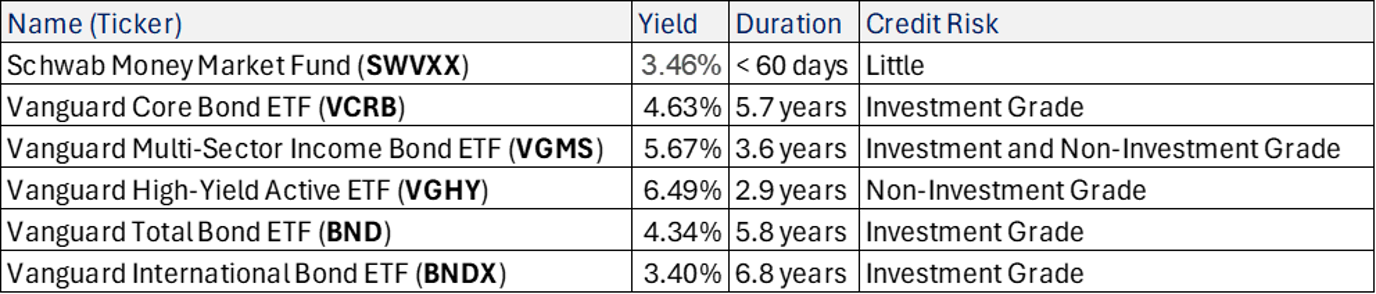
Just know even within “bond fund” investing—the risk-reward tradeoff still applies (arguably just a lot less than versus stock market investing). For example, you can see the varying yields in the table above, and the lower ones generally have less interest rate risk (lower duration—the price of longer duration bonds is more senstive to interest rate changes) and less credit risk (if the chance of default is higher—the yield is typically higher too).
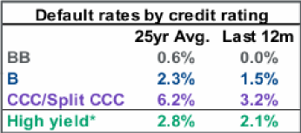
Just know (as you can see in the graphic above) the default rate on high-yield bonds is still fairly low (over history) and these bond funds hold thousands of bonds to diversify some of that risk.
Theme 5: High-Income Equities
Similar to bonds, Business Development Companies make loans and collect interest. And bond closed-end funds basically do the same (bonds are typically loans that trade in the public market). And these categories can offer some sizeable income-payments (distribution yields) to investors, as you can see in the following table.
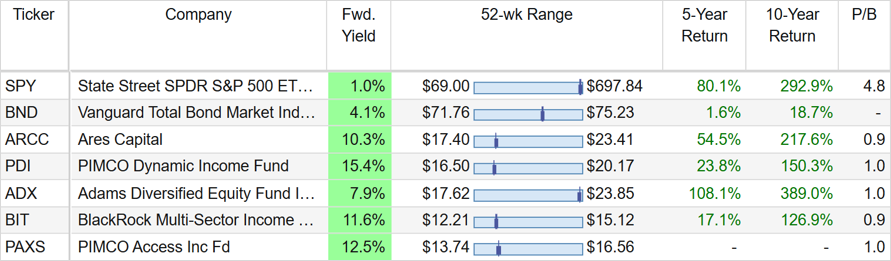
And interestingly, a lot of BDCs and Bond CEFs currently trade at discounted prices versus their net asset values (see P/B price-to-book values in the table above). You’ll also note that while equities (stocks) are now back to all time highs, high-income bond prices are still at the lower end of their range.
The Bottom Line
If you read about investing on the internet, you are constantly bombarded with ideas that may or may not be right for you. Those pushing online “advice” don’t know your situation, your volatility-tolerance, your time horizon, or your goals. And they typically don’t care.
At the end of the day, you need to do what is right for you as an investor. Understand the market dynamics and the types of opportunities that are available, and then do what is right for your situation. Be smart people. Caveat emptor!