
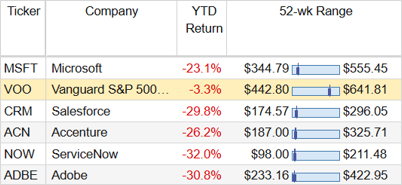
Markets are in the middle of an emotional tug-of-war over artificial intelligence. On one side is excitement about productivity gains and new revenue streams; on the other is fear that AI will commoditize software, consulting, and enterprise platforms. That fear has hit several high-quality companies hard, with shares of Microsoft, Accenture, Salesforce, ServiceNow, and Adobe down between roughly 23% and 32% year-to-date. The concerns about AI disruption are real—but they are also overdone, creating a compelling long-term opportunity in some of the most profitable businesses in tech.
AI Is Disrupting Their Business Models
The fear isn’t baseless. AI is poised to reshape how software is built, deployed, and consumed. For companies like Salesforce and ServiceNow, which sell workflow automation and enterprise applications, the rise of generative AI raises questions about whether simpler, AI-driven tools could replace traditional software layers.
Similarly, Adobe faces concerns that generative design tools could reduce the need for its premium creative suite. If users can generate high-quality images or videos with a prompt, will they still pay for advanced editing software?
Accenture’s consulting model is also under scrutiny. If AI can automate coding, analytics, and even strategic recommendations, the need for large consulting teams could shrink. Meanwhile, Microsoft—despite being a leader in AI—faces the classic innovator’s dilemma: if AI lowers barriers to entry, could it erode the value of its software ecosystem over time?
In short, AI threatens to compress pricing, reduce switching costs, and accelerate competition across all five companies.
The Reality: These Companies Are AI Winners
What the bearish narrative misses is that these companies are not bystanders—they are builders and beneficiaries of AI.
Microsoft is arguably the biggest winner, embedding AI across its cloud and productivity stack. Its Azure platform is a backbone for AI workloads, and its integration of AI into Office and enterprise tools is driving new demand.
Salesforce and ServiceNow are incorporating AI directly into their platforms to enhance automation, improve customer insights, and increase the value of their ecosystems. Rather than replacing their products, AI is making them more indispensable.
Adobe has already integrated generative AI into its creative tools, allowing users to generate and then refine content—keeping professionals within its ecosystem rather than pushing them out.
Accenture, meanwhile, is pivoting toward AI consulting, helping enterprises adopt and scale these technologies. Instead of reducing demand, AI is creating a new wave of transformation projects.
Importantly, these companies have high margins and strong pricing power. Microsoft’s gross margin sits near 69% with a 39% net margin, while Adobe boasts an even higher 89% gross margin and nearly 30% net margin. These are not fragile businesses—they are highly profitable platforms with the resources to invest aggressively in AI.
Valuations Have Reset
Despite solid fundamentals, valuations have come down meaningfully alongside share prices.
Microsoft trades at a price-to-earnings ratio around 23, while Adobe sits closer to 14. Salesforce and Accenture fall in the mid-to-high teens on forward earnings, and even high-growth ServiceNow—expected to deliver over 60% EPS growth—has seen its multiple compress.
At the same time, these companies are still growing. Microsoft is posting roughly 16% sales growth, Salesforce about 11%, and ServiceNow around 20%, with double-digit growth expected to continue across most of the group.
In other words, investors are now paying lower multiples for durable, growing businesses that are deeply embedded in enterprise operations. That combination is rare—especially in a market where high-quality tech has often commanded premium valuations.
Risks to Consider
That said, the risks should not be dismissed. AI could still lead to pricing pressure if competition intensifies or if open-source models reduce differentiation.
There is also execution risk. Integrating AI into products in a way that drives monetization—not just usage—is critical. If these companies fail to convert AI innovation into revenue, the current optimism around long-term growth could fade.
Regulatory scrutiny is another wildcard. As AI adoption accelerates, governments may impose new rules that affect data usage, pricing, or competitive dynamics.
Finally, macroeconomic conditions remain a factor. Enterprise software and consulting budgets can tighten quickly in a downturn, potentially slowing growth across the group.
The Bottom Line
The market’s reaction to AI disruption reflects a familiar pattern: fear arrives faster than clarity. While it’s true that AI will reshape the competitive landscape, it is far more likely to reinforce the position of established leaders than to displace them overnight. Companies like Microsoft, Accenture, Salesforce, ServiceNow, and Adobe are not being disrupted—they are driving the disruption.
With strong margins, steady growth, and newly compressed valuations, these stocks offer an attractive setup for long-term investors willing to look beyond near-term uncertainty. AI may change the rules of the game, but these five companies are still among the best positioned to win it.