Facebook (FB) - Thesis

Rating: Buy
Current Price: $86.73
Price Target: $ 142.50

Thesis:
Facebook’s opportunities for continued advertising revenue growth are enormous.  Rather than maximizing these opportunities as quickly as possible, Facebook CEO Mark Zuckerberg is focused on continuing to improve the user experience which he believes is ultimately better for the company’s long-term success.  As Facebook continues to improve and integrate the Facebook application, WhatsApp, Messenger, Instagram, and new innovations, the monetization opportunities via advertising make this company worth far more than its current stock price suggests.

Valuation:
Using a Discounted Cash Flow (DCF) valuation model, Facebook’s is worth $142.50 per share.  The model assumes FCF will grow 30% in 2015 to $4.7 billion, and then grow at 27.2% for the next five years before reverting to a more market normal growth rate of 3% beyond 2020.  This five year expected growth rate (27.2%) is consistent with the average estimate of over 40 professional analysts according to Yahoo!Finance.


Facebook only needs to grow at about 12% for the next five years to be worth its current market price, and based on the advertising revenue growth opportunities available, Facebook is easily worth considerably more than its current stock price suggests.

Sources of Growth:
According to Facebook’s Chief Financial Officer, David Wehner, the company has three strategic priorities.  First, is to capitalize on the shift to mobile (see Q1’15 conference call).  This has been the highest priority since the company’s initial public offering (IPO) in 2012.  Thus far, the company has allayed fears that they would not be able to profitably convert to the small screens of mobile devices, but there is more opportunity ahead.  The company is still in the early stages of mobile advertising, and has foregone enormous short-term revenue opportunities in favor of building this business prudently for long-term success.  For example, according to the company’s annual report:

“We prioritize user growth and engagement and the user experience over short-term financial results.  We frequently make product decisions that may reduce our short-term revenue or profitability if we believe that the decisions are consistent with our mission and benefit the aggregate user experience and will thereby improve our financial performance over the long term. For example, from time to time we may change the size, frequency, or relative prominence of ads in order to improve ad quality and overall user experience. Similarly, from time to time we update our News Feed ranking algorithm to deliver the most relevant content to our users, which may adversely affect the distribution of content of marketers and developers and could reduce their incentive to invest in their development and marketing efforts on Facebook.”

The bottom line here is that Facebook is trying to build for the long-term and there is huge room for growth.

Facebook’s second strategic priority is to grow advertising revenue.  This goal is noticeably second, not first, because the company recognizes the long-term importance of putting users (not advertisers) first.  During Facebook’s most recent Q1 conference call, Chief Operating Officer Sheryl Sandberg repeatedly pointed out Facebook only has a small portion of companies’ advertising revenue, and this is a truly enormous growth opportunity.

Facebook’s third strategic priority is making their applications more relevant.  This is important because it helps Facebook retain, grow and improve users, which ultimately sets up the company for long-term success.  Facebook’s other applications include WhatsApp, Instagram, Messenger, and other initiatives designed to benefit users.  Facebook recently acquired WhatsApp and Instagram, and the company hasn’t even scratched the surface yet in terms of monetizing these businesses.

Worth noting, Facebook continues to spend a large amount of money on research and development.  This supports the notion that the firm is building for long-term success by serving users rather than simply trying to monetize everything as quickly as possible so the inside owners (e.g. Mark Zuckerberg) can “cash out.”

Risks:
Stagnant or Declining User Base:  Facebook’s number one risk is its ability to retain users.  According to the company’s annual report:

“If we fail to retain existing users or add new users, or if our users decrease their level of engagement with our products, our revenue, financial results, and business may be significantly harmed.”

In other words, if people stop using Facebook, then the advertisers go away and Facebook isn’t able to make any money.  Facebook combats this risk by focusing on user experience across everything they do.  They forgo revenues to improve user experience, they constantly innovate and introduce new features and applications through a large research and development budget and by acquiring businesses (e.g. Instagram, WhatsApp) that pose a threat and/or create integration benefits.  When invetors ask CEO Mark Zuckerberg questions, his go to response always seems to be that the company is just really focused on improving the user experience.

Corporate Governance:

Facebook’s corporate governance structure introduces a variety of risks for shareholders.  For some background, Facebook founder and CEO, Mark Zuckerberg, is the largest shareholder, he has virtually complete control over the company via voting rights (there are multiple share classes, and Zuckerberg own the class with the real voting rights), and Facebook’s board is comprised of insiders and friends.  This allows Zuckerberg to take actions that are not necessarily in the best interest of shareholders, and he has already demonstrated a penchant for taking questionable actions.

For example, Zuckerberg has made some very big acquisitions (WhatsApp, Instagram); these types of acquisitions are often a symptom of a company with more cash than it needs, and rather that returning it to shareholders it is spent on the types of acquisitions which have historically destroyed value for shareholders.  Facebook may be young enough with enough growth opportunity that these acquisitions may bunk the norm and actually add value in the long-term, but they may also be the beginning of a bad habit for Zuckerberg; additional acquisitions could prove quite destructive to shareholders as often is the case.

As another example, Facebook’s board could inappropriately increase the number of shares outstanding which would be dilutive to existing shareholders.  Facebook has historically used shares to pay for acquisitions (e.g. Oculus) and to reward executives with stock options.  These types of share issuances are often not in the best interest of existing shareholders.

Mark Zuckerberg has done an exceptional job growing Facebook, but the company is still early in its public company lifecycle.  For this reason, Facebook is able to do things now that may be totally unacceptable in the future (e.g. big acquisitions, dilutive stock issuances). Inevitably, Facebook will eventually focus less on growth (because Facebook’s untapped markets will continue to decrease) and focus more on increasing the value of the business (because that will become the more profitable priority).  And as this shift occurs, Facebook’s current corporate governance will become more of a risk.

Conclusion:

Facebook continues to have significant growth and monetization opportunities ahead.  Despite some questionable corporate governance for this young public company, and despite the possible risk of a stagnating user base, Facebook is still easily worth more than it's current stock price suggests.  We own shares of Facebook, and we value the company at $142.50 per share.
 

S&P 500 ETF (SPY) - Thesis

SPDR S&P 500 ETF (SPY)
Expected Return: 8.5% per year
Expected Volatility: 16.0% per year
Rating: BUY

Thesis:
As long-term investors, we believe the equity markets will increase over time, and the SPDR S&P 500 ETF (SPY) offers reliable exposure to equity market returns while avoiding the many pitfalls that are common among other ETFs and among other equity investments in general.

Holdings:
SPY generally holds all of the securities in the S&P 500 Index (it may omit a few during transitional periods, but not enough to significantly impact performance).  The index is one of the most commonly followed equity indices in the world, and many consider it one of the best representations of the U.S. stock market, and a bellwether for the U.S. economy.  Unlike other ETFs, SPY does not hold risky derivative instruments such as futures and swaps.  The performance of SPY has historically matched the performance of the S&P 500 index very closely, and it should continue to track closely in the future because it has essentially the same holdings as the index (investors cannot purchase the actual index, and SPY is the next best thing).

Volume and Liquidity:
SPY is the world’s largest ETF, and the world’s most highly traded ETF and equity security.  This scale has two significant benefits to investors.  First, because of the volume and liquidity, the bid-ask spread is small (the bid-ask spread is the difference in price at any given time for someone buying the security and someone selling it.  There is a difference because the middle man takes a very small cut).  A small bid-ask spread is good because it saves you money when you trade.  Second, SPY trades very close to its net asset value (NAV) because of the large volume and liquidity.  NAV is the actual value if you add up the value of all the securities held within SPY.  For many less liquid ETFs, the NAV may vary from its actual market price (the price the ETF trades at in the market).  This makes SPY much less risky for investors compared to other ETFs that may vary widely in price versus NAV.  Additionally, small investors don’t have to worry about some big investor coming in, buying or selling an enormous amount of SPY, and subsequently adversely moving the market price away from its NAV because the volume of SPY is already so great that this risk is essentially non-existent.

Low Fees:
The net expense ratio on SPY is currently less than 10 basis points (0.0945%).  This is extremely low for an ETF and extremely good for investors because it allows them to achieve better returns on their investment.  For comparison, mutual funds (a common competitor to ETFs) may charge 1-2% per year, and they tend to deliver worse performance over the long-term.  Additionally, there is no expensive sales charge or separate investment advisor fee because SPY can be purchased directly through a discount broker (e.g. Scottrade, E*TRADE, TD Ameritrade, Interactive Brokers, etc.).  The discount broker may charge you a one-time trading fee of $8 or less, but this is much better than the 2-5% sales charge/management fee you’d get charged by a full service financial advisor.  Additionally, there is no hidden 25 basis point (0.025%) annual 12b-1 fee paid to someone for “servicing your account.”  The bottom line here is that SPY is a very low cost way to get great exposure to the equity market and to build considerable wealth over the long-term.

Dividend Reinvestment:
One last point of consideration, SPY pays a quarterly dividend (around 2.0% per year), and this dividend is NOT automatically reinvested back into SPY (this is standard protocol for ETFs and stocks).  This mean you’ll build up a cash balance in your account if you don’t withdraw it or manually reinvest it.  As a long-term investor, cash is generally a drag on investment performance.  Unless you plan to withdraw and use the cash, we highly recommend you develop a process to reinvest it.  Most discount brokers (Scottrade, Interactive Brokers, etc.) offer automatic dividend reinvestment programs.  We highly recommend you sign up for these programs to avoid the situation where cash builds up in your account and becomes a drag on your long-term investment performance.  Reinvesting dividends is important.


Conclusion:
SPY is a very low cost, relatively low risk, security that allows investors to build significant wealth over the long-term.  We consider SPY to be a basic building block for long-term wealth, and we rate SPY as a “Buy.”  For more information, you can view the SPY fact sheet here.

American Express (AXP) - Thesis

Rating: BUY
Current Price $77.55
Price Target: $91.46

To paraphrase Baron Rothschild, “Buy when there is blood in the streets.”  American Express is currently suffering from several serious wounds (the stock price is down 17% year-to-date while the S&P 500 is essentially flat).  First, AXP’s stock price took a hit this year from its ending exclusive card relationship with Costco.  And second, AXP has been attacked by the US government’s antitrust ruling which will allow merchants to discriminate against American Express cards for charging higher point-of-purchase fees (in theory, merchants will be incentivized to do this because AXP charges merchants higher discount fees than other cards like Visa and MasterCard).  However, the impacts of these two wounds may be less serious than perceived, and AXP may still have a few tricks up its sleeve.

Regarding the antitrust lawsuit, it’s helpful to understand how American Express’s business model is different from competing cards like Visa and MasterCard.  AXP issues its own cards through its own banks (American Express Centurion Bank and American Express Bank, FSB).  And AXP’s primary source of revenue is the discount fee charged (as a percent of the charge amount) to merchants that accept American Express cards.  Therefore, AXP’s revenue depends on the total amount spent by customers and not on the volume of transactions.  On the other hand, Visa and MasterCard are not banks, and they make money based on the volume of transactions.  As a result, the charge card industry has evolved so it is cheaper for merchants to accept Visa and MasterCard over AXP.  AXP has defended against this risk by requiring merchants to sign agreements saying they will not encourage customers to use Visa and MasterCard over AXP.  Unfortunately for AXP, recent antitrust rulings have decided these agreements are unlawful and must be eliminated.  So now the question becomes, how much business will AXP lose as a result of the antitrust ruling (which by the way, the details of the implementation of this ruling are still being determined).

For some added color, in 2014 Visa had more than 2 billion cards in use worldwide and processed more than 60 billion transactions, while AmEx had just 107 million cards in force and processed just 6 billion transaction.  Despite this disparity, American Express had annual gross revenues of $33 billion while Visa brought in just $14 billion (Forbes).  The disparity exists because American Express has built its business to attract high credit quality high transaction size customers, whereas Visa has built its business simply to attract a lot of volume (they don’t care about credit quality because they’re not on the hook for defaults like AXP is).

Regarding the loss of Costco exclusivity, the media has spun this as a very bad thing for AXP, but in reality this may not be nearly as bad as perceived.  For some background, starting in April 2016, Citigroup will replace American Express as the exclusive issuer for Costco credit cards in the U.S. (AXP’s deal with Costco in Canada ended last year) because AXP and Costco couldn’t come to terms.  Costco accounts for roughly 20% of AXP’s loans.  According to Warren Buffett (his Berkshire Hathaway is AXP’s largest shareholder) “Somebody was going to get the bid, and American Express learned a week or two ago that they were not the one that was going to get it... I don’t know the terms of the new deal, but I don’t think Citi will get rich off of it."  Merchants (such as Costco) have been pressuring card issuers for better deals, and the loss of Costco likely isn’t as big of a hit to future earnings as many people perceive simply because the terms Costco was demanding were likely less profitable for AXP than the old terms. 

Valuation:
Regarding Valuation, it is important to remember the impact of these two wounds (loss of Costco exclusivity and antitrust rulings) are already baked into the price.  What matters at this point is whether you believe the market over- or under-reacted to these events, and what do you think will happened to American Express’s business going forward.

Regarding the antitrust rulings, I believe American Express’s high-end business (remember the company targets higher spending customers) may be “stickier” than perceived.  For example, even if merchants offer a 1% discount to use non-Amex cards, customers may use AXP anyway if they know AXP is still offering them a 2% reward for the transaction.  Additionally, AXP may be able to re-optimize its discount rate to attract the customers it wants and to maintain profitability.  Further, some merchants will do anything they can to serve customers therefore some merchants simply won’t discriminate against American Express.  Another alternative for AXP is to focus more on its small but fastest growing segment (GNMS) which utilizes a business model similar to Visa and MasterCard and therefore is not being targeted by government antitrust laws.

Regarding the loss of Costco, American Express has other growth opportunities.  For example, the company has the world’s largest integrated payments platform (i.e. a global network connecting millions of consumers, businesses and merchants) which is a source of powerful data and creates many growth opportunities to better serve customers.  For instance, AXP has recently integrated with the Uber app to let AmEx card members earn double rewards points or redeem points for rides.  AmEx also formed a significant partnership with Apple Pay. Apple has designed a simple, secure, user-friendly payments feature into its latest-generation iPhones, and AmEx believes that integrating their capabilities with Apple Pay can help fuel growth in mobile payments. AmEx is also active in the startup community with ventures in a range of startups combining commerce and data science.  More broadly, AmEx has large untapped potential to benefit from the ongoing global shift into electronic payments and away from cash and checks.  According the AXP CEO, Ken Chenault “It’s not easy to see a longstanding partnership [Costco] end. But when the numbers no longer add up, it’s the only sensible outcome.”

Forward Price-to-Earnings Ratio:  Based on historical data, AXP averages a forward price-earnings ratio of 95%-100% that of the S&P 500 Index.  Using a 2015 AXP EPS estimate of $5.72 (Yahoo!Finance) and the S&P 500 forward P/E ratio recently sitting at 16.4 times, that gives American Express a price target of $91.46/share (5.72 x 16.4 x 0.975).


Financial Management:
From a financial standpoint, American Express is well-run.  First off, AXP has come under intense regulatory scrutiny since the financial crisis, and as a result its financials are very strong.  Even though AXP generates more cash than it needs to profitably operate, it still requires regulatory approval before issuing dividends or repurchasing shares.  According to the American Express annual report

“Historically, capital generated through net income and other sources, such as the exercise of stock options by employees, has exceeded the annual growth in our capital requirements. To the extent capital has exceeded business, regulatory and rating agency requirements, we have historically returned excess capital to shareholders through our regular common share dividend and share repurchase program.”

AXP has a dividend yield of around 1.5% and it has a regular share repurchase program (it repurchased over 4% of its total shares outstanding in each of the last two years).  The company returns four times as much cash to shareholders through share repurchases versus dividends signaling that AXP management may believe its stock price is undervalued.

AXP continues to make significant reallocations of its resources to optimize its business.  For example, at the end of 2014 AXP sold its investment in Concur Technologies (a travel management company) for $719 million (pre-tax), and reallocated a large portion of the proceeds to other area of its business such as marketing, promotion and awards.

Additionally, with over $44 billion of customer deposits, AXP will likely benefit if and when interest rates rise as they’ll be able to more easily cover the costs of deposits and earn an increased spread between the rates they pay and the rates they earn.


Risks and Challenges:
American Express faces a variety of risks and challenges in growing and maintaining its business.  For example, expanding outside the US presents challenges; the US economy is growing, but growth outside of the US is weak.  Additionally, the strong US dollar makes international growth a challenge.

As mentioned earlier, new regulations and the cost of co-brand relationships are both increasing.  Antitrust rulings against AXP’s discount fees and the loss of the Costco relationship are examples.

Competition in general is intensifying as both traditional players and new entrants want to disrupt the marketplace.

The derivatives used by AXP may lower volatility, but they are expensive, reduce profitability, and slow long-term growth.  For example, the forward contracts AXP uses to reduce foreign currency volatility are good for short-term earnings consistency, but bad for long-term profitability and they are making the groups that underwrite them very rich.  The same can be said of the interest rate swaps used by American Express.

AXP’s investment securities have a very large concentration of state and municipal obligations.  While these instruments may offer higher yields than treasuries they concentrate risk and have a higher likelihood of default.

Conclusion:
Buy low, sell high.  American Express (AXP) stock price has suffered in 2015, but it’s not going out of business anytime soon.  The market has reacted very negatively to recent antitrust rulings and the loss of AXP’s exclusive relationship with Costco.  However the company is still extremely profitable, it has opportunity for continued growth, and the market is valuing the stock too low.

International Developed Market ETF (ACWX) - Thesis

iShares MSCI ACWI ex U.S. ETF (ticker: ACWX)
Expected Return: 8.5% per year
Expected Volatility: 20.0% per year
Rating: BUY

Thesis:
As long-term investors, we believe the equity markets will increase over time, and the international (non U.S.) developed market (countries with developed economies) portion of the equity markets will increase at a similar rate as the U.S. markets, however they provide very important diversification benefits that are not available by investing in U.S. markets alone.  The iShares MSCI All Country World Index (ACWI) ex U.S. ETF (ticker: ACWX) offers reliable exposure to the returns of international markets while avoiding the many pitfalls that are common among other ETFs and among other equity investments in general.

Holdings:
ACWX invests in over 1,100 non-U.S. stocks from twenty-one developed market countries.  At least 90% of its assets are invested in securities of the MSCI ACWI ex U.S. Index.  The fund may invest the remainder of its assets in certain depository receipts and derivatives such as futures, options, swap contracts and cash equivalents.  The index is one of the most commonly followed equity indices in the World, and is largely considered the standard benchmark for non-U.S. developed market stocks.  The performance of ACWX has historically matched the performance of the MSCI ACWI ex U.S. Index very closely, and it should continue to track closely in the future because of its construction methodology.  Investors cannot purchase the actual index, and ACWX is the next best thing.

Volume and Liquidity:
As a standard ETF, ACWX has significant volume and liquidity (total ACWX assets exceed $1.8 billion).  Because of the volume and liquidity, the bid-ask spread is small (the bid-ask spread is the difference in price at any given time for someone buying the security and someone selling it.  There is a difference because the middle man takes a very small cut).  A small bid-ask spread is good because it saves you money when you trade.  Second, ACWX trades very close to its net asset value (NAV) because of the large volume and liquidity.  NAV is the actual value if you add up the value of all the securities held within ACWX.  For many less liquid ETFs, the NAV may vary from its actual market price (the price the ETF trades at in the market).  This makes ACWX much less risky for investors compared to other ETFs that may vary widely in price versus NAV.  Additionally, small investors don’t have to worry about some big investor coming in, buying or selling an enormous amount of ACWX, and subsequently adversely moving the market price away from its NAV because the volume of ACWX is already so great that this risk is essentially non-existent.

Low Fees:
The net expense ratio on ACWX is currently 33 basis points (0.33%).  This is extremely low for international market exposure; it is good for investors because it allows them to achieve better returns on their investment.  For comparison, international mutual funds (a common competitor to ETFs) may charge over 200 basis points (2.0%) per year, and they tend to deliver worse performance over the long-term.  Additionally, there is no expensive sales charge or separate investment advisor fee because ACWX can be purchased directly through a discount broker (e.g. Scottrade, E*TRADE, TD Ameritrade, Interactive Brokers, etc.).  The discount broker may charge you a one-time trading fee of $8 or less, but this is much better than the 2-5% sales charge/management fee you’d get charged by a full service financial advisor.  Additionally, there is no hidden 25 basis point (0.025%) annual 12b-1 fee paid to someone for “servicing your account.”  The bottom line here is that ACWX is a very low cost way to get great exposure to the equity market and to build considerable wealth over the long-term.

Dividend Reinvestment:
One last point of consideration, ACWX pays a quarterly dividend (around 2.93% per year), and this dividend is NOT automatically reinvested back into ACWX (this is standard protocol for ETFs and stocks).  This means you’ll build up a cash balance in your account if you don’t withdraw it or manually reinvest it.  As a long-term investor, cash is generally a drag on investment performance.  Unless you plan to withdraw and use the cash, we highly recommend you develop a process to reinvest it.  Most discount brokers (Scottrade, Interactive Brokers, etc.) offer automatic dividend reinvestment programs.  We highly recommend you sign up for these programs to avoid the situation where cash builds up in your account and becomes a drag on your long-term investment performance.  Reinvesting dividends is important.

Conclusion:
ACWX is a very low cost, relatively low risk, security that allows investors to build significant wealth over the long-term.  We consider ACWX to be a basic building block for long-term wealth, and we rate ACWI as a “Buy.”  For more information, you can view the fact sheet for this ETF here.


Union Pacific (UNP) - Thesis

Rating: BUY

Current Price: $95.55

Price Target: $136.20


Thesis:

We own Union Pacific because it is a great business and the stock is currently undervalued.  It’s a great business because Union Pacific has a significant amount of pricing power, access to strategic ports, room for increased efficiency and it will grow as the US economy grows.  It is currently undervalued because of a decline in coal shipments (natural gas’s current price makes it a cheap substitute) and because of an extended west coast port shutdown.  However the decline in revenue from coal is temporary because if coal shipments don’t revert to higher levels then Union Pacific will replace it with shipments of other goods.  Also the west coast port shutdown is mostly temporary.

We value Union Pacific at $136.20 per share using a 50/50 combination of discounted cash flow analysis and a valuation formula first published by Benjamin Graham (Warren Buffett’s mentor) in the 1940’s.

Pricing Power:

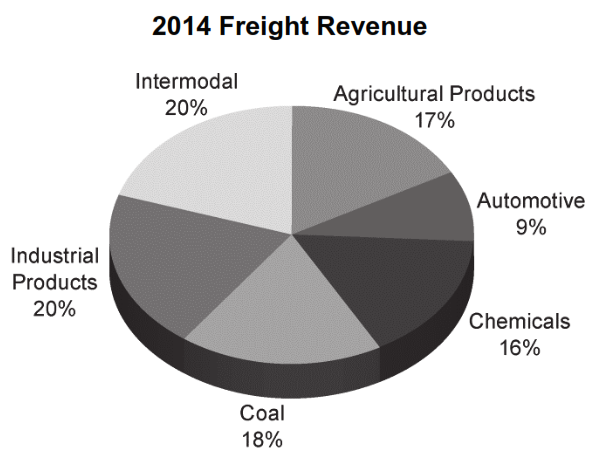
According to Warren Buffett “the single most important decision in evaluating a business is pricing power,” and Union Pacific has a tremendous amount of pricing power over its customers.  Buffet claims “if you’ve got the power to raise prices without losing business to a competitor, you’ve got a very good business. And if you have to have a prayer session before raising the price by 10 percent, then you’ve got a terrible business.”  Through its fuel surcharge program, Union Pacific has the power to raise the price of its railroad services according to fuel prices, and this is one of the reasons UNP is a very good business.  Additionally, there is more railroad demand than there is supply (people often use trucks and barges when they can’t use railroads), and this also gives UNP pricing power.  When demand for one line of UNP’s business softens (for example coal) UNP can offset the softening with another line of business (for example Agricultural products). 


Access to Strategic Ports:

UNP also has access to strategic Pacific Coast and Gulf of Mexico ports which are barriers to entry for competitors, as well as serving all six major gateways to Mexico (also a barrier for others to reproduce).  Union Pacific’s railways are an integral part of the United States transportation infrastructure, and conveniently connect to a variety of other railroads and modes of transportation.

Room for Increased Efficiency:

Even though railroads are already a more efficient and less expensive form of transportation than trucking (another common form of transportation), there is still room for increased efficiency.  According to the CEO of another US railroad company, Burlington Northern Santa Fe, long-haul trains are three times more fuel efficient than trucks.  Additionally, “William Nickle, supply chain and operations management professor at Rutgers University Business School MBA Program, explained… “One of the biggest differences between roads and railroads is that the infrastructure for trains is financed by private individuals, and the infrastructure for trucks (roadways, bridges, etc.) is financed by the government. A government that is as in as much debt as ours has not been able to invest enough to revitalize and resolve all of the current issues with the infrastructure the trucking industry relies upon.” Of course, there is still a need for intermodal transport, such trucks (and some trains) to take the freight the final leg of its journey to its destination. 

Valuation:

Discounted Cash Flow (DCF) Analysis

A DCF analysis suggests Union Pacific is worth $145.66 per share.  Union Pacific’s 2014 Free Cash Flow was around $3.14 billion (We're calculating this as Cash from Operations (+$7.385) minus Capital Expenditures (-$4.346) and adjusting for other Investing Cash Flow Items (+$0.097)).  We're assuming UNP’s required rate of return is 7.5% (this is essentially a long-term equity market assumption).  We also assume UNP can grow about 3.5% per year organically, and it’s FCF per share outstanding can grow another 1.5% per year simply by way of continued share repurchases resulting in higher future free cash flow per share because there will be less shares outstanding: FCF / (r-g) = $3.2 billion / (0.075 – (0.035 + 0.015)) = $128 billion.  $128 billion / 0.87878 billion shares outstanding = $145.66 per share.

Ben Graham Formula:

We also like to use a valuation formula first published by Benjamin Graham (Warren Buffett’s mentor) in the 1940’s:  EPS x (8.5 + (2 x growth)).  Assuming 2016 earnings per share (EPS) of $6.85 (taken from 29 professional analyst estimates on YahooFinance), and a growth rate of 5% (this is the same growth rate used in the DCF model above.  This results in a share price of $126.73 = 6.85 x 8.5 + 2 x 5.

Risks:

Union Pacific outlines a variety of risk factors in their annual report, and it is worth reviewing some of them here.  First, UNP explains:

“We Must Manage Fluctuating Demand for Our Services and Network Capacity.”  This risk is apparent in the slowdown in coal transport demand in the first half of 2015 which negatively impacted the stock price, and created a more favorable entry point for “would be” buyers of the stock.  UNP must now manage this risk by either waiting for coal business to revert back upward to historical levels, or make the changes in the mix of shipments to replace lost revenues.

“We Are Subject to Significant Environmental Laws and Regulations.” In some sense, this risk may have been reduced by the recent Supreme Court ruling against the Environmental Protection Agency which said the agency didn’t take into enough consideration the cost impact of new regulations.  While this ruling doesn’t directly impact UNP, it does impact coal plants, and it does create a regulatory environment less hostile to business. 

“Strikes or Work Stoppages Could Adversely Affect Our Operations.” This is a big one as a large percent of the workforce is unionized which can lead to significant work stoppages.  Also, this can impact shipments that UNP makes to strategic West Coast ports.  The Wall Street Journal reported “The labor dispute that caused months of gridlock at West Coast ports may be over, but the disruption is expected to redraw the trade routes that goods take to reach U.S. factories and store shelves… This is bad news for West Coast ports, truckers and railroads already worried that the expansion of the Panama Canal, due for completion next year, would begin to divert more business to the East Coast. Already it is expected to take three to six months for West Coast ports to return to normal.” (Wall Street Journal, March 5, 2015)

“We May Be Affected By Fluctuating Fuel Prices.” This noticeably impacted the company in 2014 as oil (and subsequently diesel fuel) prices declined sharply.  This was a good thing for UNP, but volatile fuel prices could move higher and hurt UNP’s profits.

Conclusion:

Union Pacific is a bet on the US economy.  As an integral part of the US economy, Union Pacific will grow as the economy grows.  As a strong free cash flow generator, UNP also has the ability to return cash to shareholders (via dividends) and increase earnings per share (by reducing the number of shares outstanding with share repurchases).  UNP’s share price has underperformed the broader stock market in 2015 due to temporarily lower revenue from coal shipments, lower revenue due to West Coast port shutdowns, and volatility in fuel costs.  The decline in share price has created an attractive entry point for investors.  We own shares of Union Pacific (UNP).

Accenture (ACN) - Thesis

Rating: BUY

Current Price: $99.48

Price Target: $116.40

We own Accenture stock because we believe the market continues to underestimate the company's ability to deliver results.  We expect the stock price to consistently outperform the market in the future because of Accenture's workforce, culture, business model, balance sheet, pipeline, relationships, brand name, management and valuation. 


WHAT DOES ACCENTURE DO?

Accenture is a management consulting, technology services and outsourcing company with over 300,000 employees and offices and operations in more than 200 cities in 56 countries.  Accenture does NOT produce any products, but rather provides business and consulting services to help clients improve business performance.  The types of services Accenture provides to its clients are difficult for many investors to understand (which is part of the reason we believe the company is undervalued).  Here are a few examples of the types of services Accenture provides: Accenture helped:

HarperCollins Publish Their Entire Catalogue of about 36,000 Books on a New Digital Platform. More from Accenture.

Shell Implement a New Logistics Strategy, Improving Service Levels and Lowering Costs Up to 25%.  More from Accenture.

The London Police Force Fight Gang Crime with Analytics. More from Accenture.

Gas Natural Fenosa Transforms Their HR Practice, Improving Employee Satisfaction by 26 Percent in One Year. More from Accenture.


AN IDEAL BUSINESS MODEL:

We love Accenture’s business model.  It is ideal because its workforce has the ability to change dramatically, quickly and smoothly to meet demand.  Much of the global workforce is still stuck on this idea that a company hires a person, that person works for 40 years, gets a gold watch, and then retires.  That model is not efficient or even realistic for much of today’s world.  Accenture is hired by companies for a specific time period (often several months at a time, to several years at a time) to complete a specific project or task, and that’s it.  It’s often unrealistic for companies to hire full time employees just to complete a specific project because the company has no need for them when the project is complete.  Accenture solves this problem because when a project for one company is complete, Accenture sends its people to work on a project for another company (many Accenture people travel domestically and internationally on a regular basis).  It’s this adaptable, mobile workforce that enables Accenture to meet the needs of its clients, and it is an ideal business model for today’s rapidly changing business environment.


ACCENTURE’S VALUE PROPOSITION:

Accenture brings high quality people with specialized skills to complete specific client projects, and then the Accenture team gets out.  It prevents the client from hiring full time employees and then laying them off, and it allows the client to benefit from the very specific skill sets and experiences that Accenture people bring.  Accenture is not cheap, but client companies regularly find Accenture’s services worthwhile from a dollars and cents perspective.  Management is willing to pay for Accenture because of the improvements and successes they are able to achieve with the help of Accenture.


EXCEPTIONAL PEOPLE AND CULTURE:

Accenture’s greatest asset is its people.  The company’s diverse and inclusive workforce combined with its opportunities for upward career advancement enables Accenture to attract some very bright people.  The typical Accenture employee is in their twenties or early thirties, enjoys living in one of the large cities where Accenture offices are typically located, and is willing (even excited) to travel domestically or internationally to client sites.  Obviously, not all employees fit this typical description (some are older, and many positions don’t require travel) but many of them do, and it fits well within the workforce.  There tends to be a pyramid shaped workforce where younger workers make up the majority of the bottom of the pyramid, and there are a lower number of employees as you move up the ranks.  This works well for Accenture because as many employees get older and want to settle down with families they depart Accenture for less demanding jobs.  This natural attrition helps Accenture manage its workforce when demand is low because natural attrition is generally easier and cheaper than layoffs.  And when demand increases, Accenture’s culture and business model enable it to quickly attract additional high caliber, hard-working, determined people.  The high quality workforce model also enables Accenture to perform at a higher level than many other companies, which is part of the reason we believe the company is such a great investment.


BRAND NAME:

Having a strong brand name is one of the most valuable assets in business because it allows you to attract employees and customers, and it allows you to charge a premium for your services.  Accenture is not usually a recognizable name to the average person walking down the street, but within the ranks of corporate America, Accenture is a very strong brand name.  A long history of delivering exceptional performance to clients is the number one reason Accenture’s brand name is strong (the Accenture brand name has been around since 2001, but the company existed long before that).  There are other important contributors to Accenture’s strong brand name such as the diverse and inclusive workforce which often receives praise from the media.  For example, Accenture was named one of the 100 best companies to work for in 2015.

According to its website, Accenture takes: “the widest possible view of inclusion and diversity, going beyond gender, race, religion, ethnicity, abilities, sexual orientation and gender identity and expression to create an environment that welcomes all forms of differences. Every employee is a respected member of our team; we value individual similarities and differences, recognizing them as the thousands of diverse pieces—or tiles—that contribute to our entire mosaic.”

According to Chief Executive Officer, Pierre Nanterme, Accenture: “gives clients access to a rich range of talent, representing different styles, perspectives and experiences. This diversity is a critical strength that we work hard to maintain and foster. It makes us a better company on every dimension.”


ACCENTURE’S FINANCIAL STRENGTH:

A quick look at Accenture’s balance sheet reveals it has almost zero long-term debt.  This demonstrates the company hasn’t required debt to grow its business recently, but they do have the ability to take on debt in the future if need be.  Since the company does not produce actual products (it’s a service company) there is no need for large capital expenditures to enable growth (other than an occasional office upgrade – Accenture had only $322 million of capital expenditures in fiscal 2014 on an enormous $3.2 billion in free cash flow).  It’s nice to know the company is not burdened with massive amounts of debt.  Accenture also has $4.9 billion of cash on hand to meet liquidity needs.  The strong balance sheet and cash flow also allows Accenture to comfortably maintain its 2% dividend and repurchase shares as management stewards capital.

FUTURE GROWTH:

Accenture’s estimated earnings growth rate over the next five years is 10.13% according to 28 professional analysts covering the stock.  This exceeds the 7.28% those analysts are forecasting for the S&P which suggest they believe Accenture will grow faster than average.  We tend to agree Accenture will grow faster than the market, but we also believe it will grow faster than these analysts’ estimates.  Wall street consistently underestimates the value of this company because they do not have a strong enough appreciation for Accenture’s business model, it’s exceptional workforce & culture, and it’s powerful brand name within corporate America.  We also believe Accenture’s business is difficult for many people to understand, which causes them to avoid and under appreciate the stock. 

Near-term growth is expected to be generated across Accenture’s business groups, however Accenture Digital is the “hot” area right now.  According to Accenture’s 2014 annual report, the company recently launched Accenture Digital by combining their capabilities in digital marketing, analytics and mobility.  With more than 28,000 professionals, Accenture Digital is the world’s largest end-to-end digital capability and works with many industry leaders—including all of the top 10 global pharmaceutical companies as well as all of the top 10 consumer products companies.  In our view, there is a new “big thing” at Accenture with every market cycle (this time it seems to be digital).  However, it’s Accenture’s dynamic and adaptable workforce that enables it to profit from the market’s needs across market cycles.


VALUATION:

Ben Graham Formula:

We use a modified version of the valuation formula published in the 1930’s by Benjamin Graham (Warren Buffett’s mentor) to value Accenture at $116.55 per share.  Using Graham’s original formula (assuming a 5% growth rate), Accenture is worth only $101.97 per share [share price = EPS x (8.5 + 2 x growth) + cash per share = 5.18 x (8.5 + 2 x 5) + 4.9/0.79758.  However, we bump the growth rate up to 7% ($116.55 = 5.18 x (8.5 + 2 x 7) + 4.9/0.79758) because the company’s strong free cash flow will allow it to consistently strengthen EPS growth incrementally (as needed) with share repurchases, and we believe management is incentivized to do this as their compensation is tied to the stock price.


Discounted Cash Flow (DCF) Model:

Using a discounted cash flow model, we value Accenture at $116.25 per share.  Our model assumes Accenture can grow its 2014 free cash flow of $3.2 billion by 5% for the next five years and then 3% into perpetuity.  We assume a CAPM-derived required rate of return of around 8.3% and a long-term equity market return assumption of 7.5%.  We used a discount rate of 3%, and factored in the $4.9 billion of cash on hand.


RISKS:

The number one largest risk to Accenture’s business is anything that could hurt its brand name.  Because it doesn’t actually produce products (it’s a services company), a lawsuit or bad publicity could destroy the company’s ability to attract new business.  Accenture knows this lesson very well because of its history. Accenture was formerly part of Arthur Andersen, an accounting firm that was completely destroyed a little over a decade ago when the fraudulent actions of a few partners destroyed the company’s reputation and forced it to lay off thousands of employees and go completely out of business.  Accenture separated from Arthur Andersen several years before the scandal.  Accenture was known as Andersen Consulting when it first separated and then brilliantly changed its name to Accenture before the Arthur Andersen scandal allowing it to avoid unnecessary fallout from Arthur Andersen.  As another example of Accenture’s extreme aversion to bad publicity look to the Tiger Woods example.  Tiger Woods was paid huge sums of money to be the face of Accenture’s advertising and marketing initiatives, until a few years ago when news of Tiger’s indiscretions hit the news.  Tiger’s face had been pasted all over Accenture’s website and advertisements around the world, but within hours of the news Accenture’s leadership decided to drop Tiger Woods and remove his image from everything as quickly as possible.  This is a perfect example of how committed Accenture’s leadership is to protecting its pristine brand name, and of the lengths it will go to defend it.  Accenture leadership gets it.


CONCLUSION:

Accenture is a well-run, highly-profitable business, with a workforce well-suited for a rapidly evolving marketplace.  Its stock price is also inexpensive relative to its value.  We believe the market continues to underappreciate Accenture’s ability to deliver and its overall value.  We own shares of Accenture stock.