

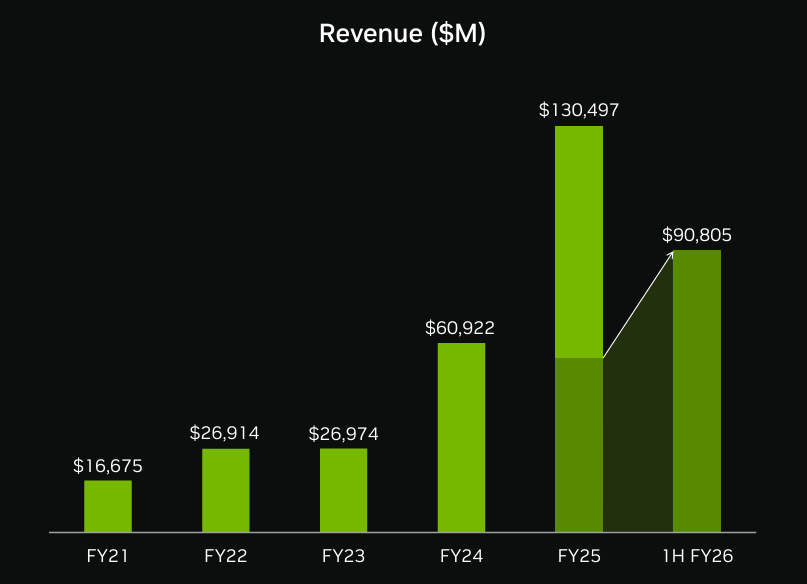
If you have “Nvidia fatigue,” get over it. Despite the existing bottlenecks (not ASML or Taiwan Semiconductor, but SK Hynix), Nvidia’s revenue (and share price) have room to go dramatically higher as indicated by President Trump’s upcoming UK trip (with Sam Altman and Jensen Huang) and the newly announced SK Hynix HBM4 (which can increase the supply of Nvidia chips without quenching demand or impacting Nvidia’s pricing power). This report reviews Nvidia’s disruptive growth (i.e. the cloud-AI megatrend), the two imminent new growth signals (mentioned above), current valuation and risks, and then concludes with a strong opinion on investing.
About Nvidia’s Disruptive Growth
Nvidia designs the leading graphics processing units (“GPUs”) used in data centers and powering the cloud and AI megatrends. Demand is off the charts, and it is slowed only by certain supply chain bottlenecks.
Nvidia’s Bottlenecks
A lot of people know Nvidia designs GPUs but that production is outsourced to world-leading foundry, Taiwan Semiconductor (TSM). And while some people incorrectly assume the supply of Nvidia chips is limited by TSM (it’s not—they have plenty of wafer fab capacity) or by the company that builds the machines TSM uses to produce Nvidia chips (aka ASML, which is also not the bottleneck), the actual stick in the mud is SK Hynix (the primary provider of High Bandwidth Memory, or “HBM,” which requires costly advanced machines for precise chiplet stacking, and has limited global supply). This HBM scarcity has limited Nvidia’s ramp-up.
New SK Hynix HBM 4 Release
Fortunately, that is about to change (albeit only incrementally) as SK Hynix just announced they completed development of the more efficient HBM4 (i.e. the next-generation HBM for AI applications) and it is ready for mass production. For perspective, SK Hynix is sold out through 2025 on HBM3E (for Nvidia Blackwell chips), but the company’s partnership with Nvidia, including exclusive deals, positions Nvidia for strong growth as they address HBM shortages in the face of insatiable AI chip hunger. This is good news for Nvidia, especially considering the HB4s have 40% improved power efficiency compared to HBM3E (as energy use is the next big constraint on AI growth).
Trump’s Big Upcoming UK Visit
This week President Trump (along with Nvidia CEO Jensen Huang and OpenAI founder Sam Altman) are headed to the UK for a state visit to discuss massive AI datacenter growth, including the need for energy to power the megatrend. This is another clear indication that Nvidia’s growth isn’t about to slow, but rather rapid growth has the US President and leading AI company CEOs concerned. This is another good sign for Nvidia.
Nvidia’s Current Valuation
Amazingly, despite the incredible price increase for Nvidia shares in recent years, the company is still relatively inexpensive as compared to its growth. For example, as you can see in the following table, the shares have much higher growth than other mega caps (also benefitting from AI), but a much more attractive (lower) forward price-to-earnings-to-growth (“PEG”) ratio (currently 0.7x, attractive!).
A lot of people are fearful of Nvidia’s massive market cap gains in recent years, and are quick to suggest the company (along with other mega caps) are in bubble territory. But the high growth, strong margins, and low valuation multiples (particularly for Nvidia) tell a different story. Nvidia is attractive.
The Risks
Customer Concentration is a risk for Nvidia considering its heavy reliance on few hyperscalers (e.g. Microsoft, Amazon) for 40%+ of revenue. Any abrupt spending cuts will impact Nvidia.
Geopolitical Tensions: US-China export restrictions and tariffs limit China sales, a major market. Plus, the upcoming UK visit adds to international trade risks.
Competition is another risk. Even through Nvidia is currently the dominant AI chip leader, rivals (including AMD and Broadcom), may succeed in eroding Nvidia’s AI GPU market share.
Supply Chain Bottlenecks such as HBM shortages (as discussed above) do constrain Nvidia’s Blackwell production and growth.
Conclusion
There are absolutely risks to investing in Nvidia, but the low valuation multiples, combined with the massive growth trajectory, provide investors with a healthy margin of safety. And Trump’s upcoming UK visit, combined with the SK Hynix news, suggests the growth isn’t about to slow.
If you are a long-term growth investor, Nvidia shares are absolutely worth considering for a spot (a big spot considering it’s such a massive part of the public equity market and of the total economy) in your prudently concentrated portfolio. Disciplined, goal-focused, long-term investing continues to be a winning strategy. Be smart people, do what is right for you.