Walt Disney (DIS) Update - New Films and ESPN Fears

Disney (DIS) stock continues present a great buying opportunity as it trades about 13% off its 52-week high.  The stock declined sharply after last quarter's earnings announcement where they missed earnings estimates and expressed fears that ESPN will lose more customers as young people continue to cut the (cable) cord.  However, there is a lot more to this amazing company than ESPN.  For example, the upcoming Star Wars movie should create a big boost for revenues.  Disney released its updated movie schedule this week, and you can view it below.  And to read our complete Disney research report, click here

  • June 16, 2017: “CARS 3”
  • Nov. 22, 2017: “Coco”
  • Dec. 22, 2017: “Untitled Disney Fair Tale – Live Action”
  • Feb. 16, 2018: “Black Panther”
  • March 9, 2018: “Gigantic”
  • June 15, 2018: “Toy Story 4”
  • July 6, 2018: “Ant-Man and the Wasp”
  • Nov. 2, 2018: “Untitled Disney Fairy Tale – Live Action”
  • March 8, 2019: “Captain Marvel”
  • March 29, 2019: “Untitled Disney Fairy Tale – Live Action”
  • April 12, 2019: “Untitled Disneytoon Studios”
  • June 21, 2019: “The Incredibles 2”
  • Nov. 8, 2019: “Untitled Disney Fairy Tale – Live Action”
  • March 13, 2020: “Untitled Pixar Animation”
  • May 1, 2020: “Untitled Marvel”
  • June 19, 2020: “Untitled Pixar Animation”
  • July 10, 2020: “Untitled Marvel”
  • Nov. 6, 2020: “Untitled Marvel”
  • Nov. 25, 2020: “Untitled Disney Animation”

release schedule source: Wall Street Journal

Johnson & Johnson (JNJ) - Thesis

Rating: BUY

Current Price: $95.06

Price Target: $122.60


Thesis:
Johnson & Johnson is a blue chip among blue chip companies, and now is an excellent time to buy.  JNJ has an amazing track record of increasing its adjusted earnings for 31 consecutive years and increasing its dividend for 53 consecutive years.  The dividend yield is currently an attractive 3.2%, and the stock price has recently pulled back making now a great time to buy.

Overview:
Operating across its three main segments (Consumer, Pharmaceutical, and Medical Devices), the company is home to many names you’ve heard of (e.g. Band-Aid, Tylenol, Listerine, Visine) and many other great health care products people rely on around the world (you can view the company’s products here).  In fact, Johnson & Johnson sells products in virtually every country in the world.  The company’s global sales gives investors an added level of diversification beyond just the diversified products and business segments.  In 2014, JNJ had $74.3 billion in total sales.  Forty-three percent of the sales came from the Pharmaceutical segment, 37% from Medical Devices and the remaining 20% from the Consumer segment.

Valuation:
We value JNJ using a 50/50 combination of discounted free cash flows and Ben Graham’s (EPSx(8.5+2xGr)) formula.  In both valuations, we assume the company can grow at 5% per year.  The average 5-year earnings growth estimate of the 19 professional analysts included on Yahoo Finance is 4.96%.  We believes JNJ provides will benefit from a global demographic trend which the company aptly explains as follows: “the historic aging rate of the world’s population, along with a growing middle class around the world, brings dramatically greater demand for higher quality health care” (Annual Report, p.3).  Our discounted cash flows analysis uses a 9% required rate of return (CAPM derived), and values JNJ at $131.54 per share.  Graham’s formula assigns the company a $113.65 price per share.  We use the average of the two to value JNJ at $122.60, which is well above its current price.

Cash:
JNJ has a history of returning cash to shareholders through dividends and share buybacks.  As mentioned previously, the dividend has increased for 53 consecutive years.  In aggregate, the company paid $7.8 billion for dividends in 2014.  They also repurchased $7.1 billion of its own stock (this is another way to return cash to shareholders).

Buying Opportunity:
JNJ’s stock price is down this year for two main reasons, and the fact that it is down makes now a good time to buy.  First, JNJ is down with the rest of the broader market.  As bad economic data out of China and jitters about the US Federal Reserve’s upcoming interest rate hike have hit JNJ just like almost every other stock in the market.  And second, JNJ earnings are being hurt by foreign currency fluctuations.  Specifically, the strong US dollar makes international sales less profitable for the company.  However, these two things make JNJ more attractive now than it was before because the broad market pullback is only temporary (the world will go on) and foreign currency volatility is stabilizing. (currency markets have been highly volatile since the “Great Recession” on 2008-2009). 

Conclusion:
The main reason most individual investors buy Johnson & Johnson stock is for the dividend.  It’s a steady stable company, and the dividend payments keep rolling in quarter after quarter.  However, the stock also offers the opportunity for capital appreciation.  And while there is no guarantee the stock price will go up tomorrow, this month, or this year, we believe strongly it will go up over the long-term.  As the company says “the historic aging rate of the world’s population, along with a growing middle class around the world, brings dramatically greater demand for higher quality health care,” and JNJ is a leader in meeting these needs.

American Express Update - Sam's Club

It was announced this week that American Express cards will soon be accepted at Sam's Club (the eighth largest U.S. retailer and a leading membership warehouse club for small businesses and consumers).  We view this as an incremental positive for American Express (AXP), especially after losing their exclusivity deal with Costco earlier this year.

We consider now a great time to invest in American Express because the stock is trading at an attractive valuation.  The valuation is attractive because the market over-reacted to some negative news earlier this year (i.e. AXP has underperformed the broader market year-to-date due to the loss of Costco exclusivity as mentioned above, and due to a negative antitrust ruling).  However, AXP is still an extremely profitable company, with lots of room to grow, and an attractive dividend yield.  You can read our complete AXP thesis here.

P&G Update - Dividend Yield Highest in 25 Years

Now is a great time to initiate a position in Procter & Gamble (or increase an existing position).  As P&G’s stock price has declined over the last few weeks (along with declines in the overall stock market), the company’s dividend yield has increased to its highest level in almost 25 years (it’s been hovering around 3.7% to 3.8%).  P&G is a stalwart blue chip that generates around $11 billion in free cash flow every year, and the dividend is one of the safest in the world (i.e. this dividend is not going to be reduced). 

For some background, P&G’s stock price has been hammered over the last year by severe foreign currency headwinds (the US dollar has been strong) and a variety of (soon-to-be eliminated) sub-optimal market ventures.  However, knowing that the foreign currency headwinds are normalizing and P&G’s restructuring is progressing, now is a great time to buy.

Also worth noting, P&G’s CEO A.G. Lafley will be replaced on November 1st by David Taylor (David has been with P&G since 1980, and most recently was head of the company’s global beauty grooming and health-care division).  This was Lafley’s second go-round as CEO (they brought him out of retirement to lead the company’s recent restructuring), and Lafley will remain on as Chairman to help with the transition.  You can read our full report on P&G here.
 

U.S. Value Stock ETF (IWD) - Thesis

iShares Russell 1000 Value ETF (ticker: IWD)
Expected Return: 8.75% per year
Expected Volatility: 18.0% per year
Rating: BUY

Thesis:
As long-term investors, we believe the equity markets will increase over time, and the “value” portion of the equity markets will increase at a slightly better rate than the rest of the market.  Value stocks are defined as stocks with lower price-to-book ratios and less aggressive earnings growth expectations.  They’re basically stocks that are on sale.  Empirical research has shown that value stocks have outperformed the rest of the market over the long-term (10+ year periods).  Additionally, value stocks have moderately under-performed the rest of the markets over the last several years which makes them even more attractive (because they’re on sale).  We believe the reason value stocks have underperformed in recent years is because the accommodative monetary policies of the U.S. Federal Reserve since the great recession in 2009 have favored “growth” stocks.  Specifically, stocks that need to borrow more money to grow have been able to borrow it at attractively low rates because of the low interest rates set by the Fed.  As the Fed raises rates over the coming market cycle (they next three to 10 years) this will be a headwind to growth stocks and it will favor value stocks.  Regardless of where we’re at in the market cycle, value stocks tend to outperform over the long-term, and the Russell 1000 Value ETF (ticker: IWD) offers reliable exposure to the returns of value stocks while avoiding the many pitfalls that are common among other ETFs and among other equity investments in general.

Holdings:
IWD invests in over 650 large US companies classified as “value” stocks.  At least 90% of its assets are invested in securities of the Russell 1000 Value Index.  The fund may invest the remainder of its assets in certain derivatives such as futures, options, swap contracts and cash equivalents.  The index is one of the most commonly followed equity indices in the World, and is largely considered the standard benchmark for U.S. large company value stocks.  The performance of IWD has historically matched the performance of the Russell 1000 Value Index very closely, and it should continue to track closely in the future because of its construction methodology.  Investors cannot purchase the actual index, and IWD is the next best thing.

Volume and Liquidity:
As a standard ETF, IWD has significant volume and liquidity (total IWD assets exceed $23.5 billion).  Because of the volume and liquidity, the bid-ask spread is small (the bid-ask spread is the difference in price at any given time for someone buying the security and someone selling it.  There is a difference because the middle man takes a very small cut).  A small bid-ask spread is good because it saves you money when you trade.  Second, IWD trades very close to its net asset value (NAV) because of the large volume and liquidity.  NAV is the actual value if you add up the value of all the securities held within IWD.  For many less liquid ETFs, the NAV may vary from its actual market price (the price the ETF trades at in the market).  This makes IWD much less risky for investors compared to other ETFs that may vary widely in price versus NAV.  Additionally, small investors don’t have to worry about some big investor coming in, buying or selling an enormous amount of IWD, and subsequently adversely moving the market price away from its NAV because the volume of IWD is already so great that this risk is essentially non-existent.

Low Fees:
The net expense ratio on IWD is currently 20 basis points (0.20%).  This is extremely low for value stock exposure; it is good for investors because it allows them to achieve better returns on their investment.  For comparison, value mutual funds (a common competitor to ETFs) may charge over 150 basis points (1.5%) per year, and they tend to deliver worse performance over the long-term.  Additionally, there is no expensive sales charge or separate investment advisor fee because IWD can be purchased directly through a discount broker (e.g. Scottrade, E*TRADE, TD Ameritrade, Interactive Brokers, etc.).  The discount broker may charge you a one-time trading fee of $8 or less, but this is much better than the 2-5% sales charge/management fee you’d get charged by a full service financial advisor.  Additionally, there is no hidden 25 basis point (0.025%) annual 12b-1 fee paid to someone for “servicing your account.”  The bottom line here is that IWD is a very low cost way to get great exposure to the equity market and to build considerable wealth over the long-term.

Dividend Reinvestment:
One last point of consideration, IWD pays a quarterly dividend (around 2.49% per year), and this dividend is NOT automatically reinvested back into IWD (this is standard protocol for ETFs and stocks).  This means you’ll build up a cash balance in your account if you don’t withdraw it or manually reinvest it.  As a long-term investor, cash is generally a drag on investment performance.  Unless you plan to withdraw and use the cash, we highly recommend you develop a process to reinvest it.  Most discount brokers (Scottrade, Interactive Brokers, etc.) offer automatic dividend reinvestment programs.  We highly recommend you sign up for these programs to avoid the situation where cash builds up in your account and becomes a drag on your long-term investment performance.  Reinvesting dividends is important.

Conclusion:
IWD is a very low cost, relatively low risk, security that allows investors to build significant wealth over the long-term.  We consider IWD to be a basic building block for long-term wealth, and we rate IWD as a “Buy.”  For more information, you can view the fact sheet for this ETF here.

U.S. Small Companies ETF (IWM) - Thesis

iShares Russell 2000 Index ETF (IWM)
Expected Return: 8.75% per year
Expected Volatility: 20.0% per year
Rating: BUY

Thesis:
As long-term investors, we believe the equity markets will increase over time, and the small cap portion of the equity markets will increase more than the large cap portion, albeit with more volatility.  The iShares Russell 2000 Index ETF (IWM) offers reliable exposure to the returns of the small cap portion of the U.S. equity market while avoiding the many pitfalls that are common among other ETFs and among other equity investments in general.

Holdings:
IWM invests at least 90% of its assets in securities of the Russell 2000 Small Cap Index.  The fund may invest the remainder of its assets in certain derivatives such as futures, options, swap contracts and cash equivalents.  The index is one of the most commonly followed equity indices in the U.S., and is largely considered the standard benchmark for small cap stocks.  The performance of IWM has historically matched the performance of the Russell 2000 Small Cap Index very closely, and it should continue to track closely in the future because of its construction methodology.  Investors cannot purchase the actual index (the Russell 2000 Small Cap Index), and IWM is the next best thing.

Volume and Liquidity:
As the standard small cap ETF in the US, IWM has significant volume and liquidity (total IWM assets exceed $28 billion).  Because of the volume and liquidity, the bid-ask spread is small (the bid-ask spread is the difference in price at any given time for someone buying the security and someone selling it.  There is a difference because the middle man takes a very small cut).  A small bid-ask spread is good because it saves you money when you trade.  Second, IWM trades very close to its net asset value (NAV) because of the large volume and liquidity.  NAV is the actual value if you add up the value of all the securities held within IWM.  For many less liquid ETFs, the NAV may vary from its actual market price (the price the ETF trades at in the market).  This makes IWM much less risky for investors compared to other ETFs that may vary widely in price versus NAV.  Additionally, small investors don’t have to worry about some big investor coming in, buying or selling an enormous amount of IWM, and subsequently adversely moving the market price away from its NAV because the volume of IWM is already so great that this risk is essentially non-existent.

Low Fees:
The net expense ratio on IWM is currently 20 basis points (0.20%).  This is extremely low for small cap market exposure; it is good for investors because it allows them to achieve better returns on their investment.  For comparison, small cap mutual funds (a common competitor to ETFs) may charge over 200 basis points (2.0%) per year, and they tend to deliver worse performance over the long-term.  Additionally, there is no expensive sales charge or separate investment advisor fee because IWM can be purchased directly through a discount broker (e.g. Scottrade, E*TRADE, TD Ameritrade, Interactive Brokers, etc.).  The discount broker may charge you a one-time trading fee of $8 or less, but this is much better than the 2-5% sales charge/management fee you’d get charged by a full service financial advisor.  Additionally, there is no hidden 25 basis point (0.025%) annual 12b-1 fee paid to someone for “servicing your account.”  The bottom line here is that IWM is a very low cost way to get great exposure to the equity market and to build considerable wealth over the long-term.

Dividend Reinvestment:
One last point of consideration, IWM pays a quarterly dividend (around 1.36% per year), and this dividend is NOT automatically reinvested back into IWM (this is standard protocol for ETFs and stocks).  This mean you’ll build up a cash balance in your account if you don’t withdraw it or manually reinvest it.  As a long-term investor, cash is generally a drag on investment performance.  Unless you plan to withdraw and use the cash, we highly recommend you develop a process to reinvest it.  Most discount brokers (Scottrade, Interactive Brokers, etc.) offer automatic dividend reinvestment programs.  We highly recommend you sign up for these programs to avoid the situation where cash builds up in your account and becomes a drag on your long-term investment performance.  Reinvesting dividends is important.

Conclusion:
IWM is a very low cost, relatively low risk, security that allows investors to build significant wealth over the long-term.  We consider IWM to be a basic building block for long-term wealth, and we rate IWM as a “Buy.”  For more information, you can view the IWM fact sheet here.
 

Facebook (FB) Update - Oculus V.R.

Facebook purchased virtual reality company Oculus for $2 billion last year, and it seems they are about to begin monetizing that purchase.  Facebook and smart-phone giant Samsung will launch a $99 virtual reality headset in November called the Gear VR.  Facebook has struck deals with a variety of video game companies to create content, and the possibilities to grow and evolve the virtual reality headset business are vast.  We view this as an incremental positive for Facebook, and we continue to hold the stock and believe in the business going forward.  You can view our complete Facebook thesis here.

Accenture (ACN) - Update - Earnings

Accenture announced earnings this morning and exceeded market expectations for both top line revenue and bottom line net income.  And the results would have been even better had it not been for foreign currency headwinds.  The main driver of Accenture's continued growth is a surge in digital services revenue and cloud services business.

Also encouraging, Accenture announced they are increasing their dividend by 8% and adding $5 billion to its share repurchase program.  Both of these are good things because it is a return of cash to shareholders.  Even though Accenture is growing quickly it still generates more cash than it needs, and is able to return a lot of it to shareholders.

Accenture's stock price has declined slightly this morning mainly because the overall market is down slightly.  However, the company also gave guidance for next year's earnings in a range of $5.09 to $5.24 per share, slightly below street expectations of $5.22 per share.

Bottom line, this is a great business, that generates lots of cash and continues to grow.  You can check out our complete thesis on Accenture here.

The Walt Disney Company (DIS) - Thesis

The Walt Disney Company (DIS)
Rating: BUY
Current Price: $101.57
Price Target: $115

Thesis:
The Walt Disney Company (DIS) is a behemoth of valued brands, with lots of cash flows, strong earning power, a decent dividend, and it’s currently on sale.  We value DIS at $115 per share using a 50/50 combination of a discounted cash flow model and a valuation formula first published by Benjamin Graham, Warren Buffett’s mentor, in the 1940’s.  Disney’s stock price declined in August after missing Wall Street revenue estimates, and then it never recovered as market-wide declines kept the stock price down.  Relative to its current market price, we believe Disney has significantly more upside than the overall stock market.  We rate Disney a buy, and we own the stock.

Overview:
Disney divides itself into five business segments: (1) media networks, (2) parks and resorts, (3) studio entertainment, (4) consumer products and (5) interactive media. Media Networks comprise an array of broadcast, cable, radio, publishing and digital businesses across two divisions – the Disney/ABC Television Group and ESPN Inc. Walt Disney Parks and Resorts (WDP&R) is a provider of family travel and leisure experiences. The Walt Disney Studio brings movies, music and stage plays to consumers throughout the world. Disney Consumer Products (DCP) delivers product experiences across thousands of categories from toys and apparel to books and fine art. Disney Interactive is a creator of interactive entertainment across all current and emerging digital media platforms.

Growth:
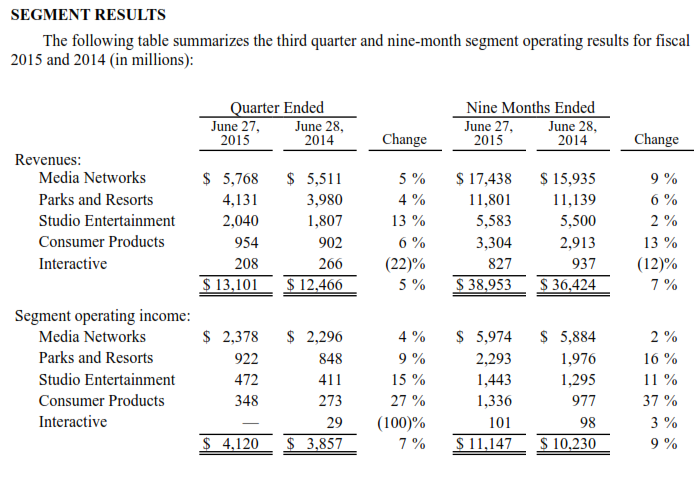
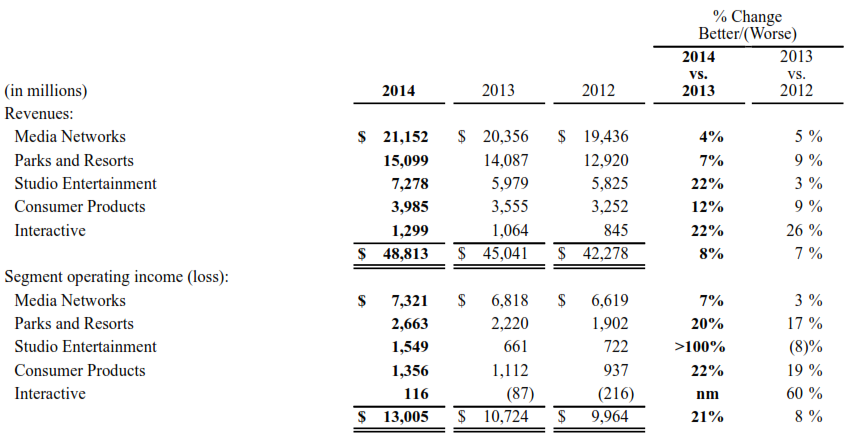
“Media Networks” (Disney/ABC television and ESPN) contributes the most revenue and operating income, but the company generates growth across its diversified business segments as shown in the following segment results tables:

In addition to the past performance provided in the tables above, Disney management provides forward guidance indicating strong expected future growth.  For example, along with its third quarter earnings release, the company stated that it should see mid-single digit growth in fiscal year 2016 due to the strengthening of dollar and modest subscriber losses at its cable networks.

Additionally, Disney expects its upcoming release of the movie “Star Wars: The Force Awakens” to generate significant growth for the company.  Another source of significant growth is expected to come from Disney’s Shanghai theme park resort which is expected to be operational by Spring 2016.

Valuation:
A quick discounting of Disney’s free cash flow suggests the company is trading at an attractive price.  Calculating free cash flow as cash flow from operations ($9.8 billion) minus capital expenditures ($3.3 billion), and then discounting this by the company’s weighted average cost of capital (~8.3%), and assuming it can grow at 7.5% per year for the next 5 years, followed by 3.0% per year thereafter, gives us a present value of ~$198 billion, which is more than 15% upside versus its current market cap of $172 billion.  Considering Disney has 1.69 billon shares outstanding, this gives us a valuation of $117 per share.

As a second estimate of Disney’s valuation, we use a formula first published by Benjamin Graham (Warren Buffett’s mentor) in the 1940’s (EPS x (8.5 + 2 x growth)).  We assume earnings will grow by 14.0% for the next five years (this is the average 5-year earnings growth estimate, per year, by the 32 analysts surveyed on Yahoo Finance), and then we assume earnings will grow by 3% per year thereafter.  This gives us a valuation of $112 per share which is about 11% upside versus the current share price.  Importantly, this is a conservative estimate because if Disney is able to grow faster than 3% after five years, then the company is worth more than this valuation suggests.

Risks:
Perhaps the biggest risk to Disney is anything that could damage its strong brand reputation.  According to Forbes, Disney is the 11th most valuable brand in the world.   Related to Disney’s brand, the company notes the following risk in their annual report: “Changes in public and consumer tastes and preferences for entertainment and consumer products could reduce demand for our entertainment offerings and products and adversely affect the profitability of any of our businesses.”  Further, Disney notes: “The success of our businesses is highly dependent on the existence and maintenance of intellectual property rights in the entertainment products and services we create.”

Another significant risk noted by Disney is simply that “changes in U.S., global, or regional economic conditions could have an adverse effect on the profitability of some or all of our businesses.”  Certainly a global economic downturn could adversely affect Disney as the company’s products aren’t a bare necessity, and could suffer from a reduction in consumer spending.

Another risk noted by Disney is that “changes in our business strategy or restructuring of our businesses may increase our costs or otherwise affect the profitability of our businesses.”  Certainly, Disney is a large company, with multiple business segments and lots of moving parts.  Any missteps in any part of the company could affect the organization as whole.

Conclusion:
Disney’s stock price is cheap right now relative to its value, and this likely won’t be the case for long.  With great earnings power, strong cash flows, a decent dividend, and growth potential from the likes of the new Star Wars movie and the new Shanghai theme park, Disney is an outstanding blue chip stock to own for the long-term.

US Bancorp (USB) Update: Preparing to Cut Cost

US Bancorp CEO, Richard Davis, said in a recent Wall Street Journal article that his bank is preparing for cost-cutting measures if interest rates don't rise soon.  USB's revenues are split between fee revenue and interest rate sensitive revenues, but the low interest rate environment is still putting significant strain on the company. Irrespective of interest rates, USB is a very well-run bank with a healthy dividend that is in no way in jeopardy.  We continue to hold the stock as we believe it trades below its intrinsic value.  And if interest rates do eventually rise, that will be an incremental positive for the bank.  You can read our complete thesis here.

Facebook (FB) Update - Monetizing Instagram

Facebook announced today they are opening up Instagram to more advertisers, and the stock price is up moderately.  Facebook has consistently stated they prioritize user experience ahead of short-term profit maximization, and this is why they continue to leave enormous amounts of monetization opportunity (advertising dollars) on the table.  As shareholders, we agree with Facebook’s priority because we believe it makes the company worth more in the long-run.


We view today’s announcement as a positive signal that Facebook is comfortable they can ramp up advertising to some extent without overly compromising user experience. The increased advertising dollars should pass through to the bottom-line.  We also believe that Facebook will find more ways to monetize the business in the future without significantly detracting from user experience.  We believe the stock (FB) has significantly more upside from here because significant monetization opportunities remain.  You can view our complete Facebook thesis here.
 

Union Pacific (UNP) Update

Union Pacific’s (UNP) stock price has continued to decline since our June 30th thesis, and the decline continues to be overdone.  The decline has been driven partially by a slowdown in business (for example, operating revenue was down 10 percent in the second quarter versus the second quarter of 2014).  However, a larger portion of the decline has been driven by a “global economic slowdown” narrative that is overdone.

Union Pacific continues to generate an enormous amount of free cash flow, and is working to “right size” the business.  According to UNP CEO, Lance Fritz, “Total volumes in the second quarter were down 6 percent, led by a sharp decline in coal.  Industrial products and agricultural products also posted significant volume decreases.  However, we made meaningful progress right sizing our resources to current volumes.”  Also worth noting, the company did experience growth in automotive and intermodal during the period.

Year-to-date, Union Pacific’s stock is down nearly 17% while the S&P 500 is down only 8%.  However, UNP still generated more cash from operations in the first six months of this year than it did for the first six months of 2014.  Additionally, UNP’s diversified rail businesses are resilient, and the organization continues to “right size” its operations for the current environment.  Fears of a dramatic global slowdown fueled by a China pullback are overdone.  Union Pacific stock is undervalued, and it represents an exceptional long-term investment opportunity.  To read our complete Union Pacific thesis, click here.

McDonald's (MCD) All Day Breakfast

McDonald's (MCD) announced yesterday that they'll begin serving all-day-breakfast on October 6th.  Breakfast has been McDonald's best selling daypart, and this is, of course, an effort to increase profitability for the fast-food giant.  The market likes the news so far, as the stock is up over 2% this morning (the market is only up ~1%).

Remember, even though MCD's earnings missed estimates and declined in 2014, Q1-15 and Q2-15, the firm still generates enormous cash flow, and we believe the stock is worth considerably more than its current market price suggests.  You can read our full McDonald's thesis here.

American Express (AXP) Update


American Express was up 6% near the market-close on Friday as information emerged that Value Act Capital Management may have acquired a nearly 5% stake in the firm.  According to American Express spokeswoman Marina Norville:

"ValueAct is a well-respected firm.  We have been speaking with them, as we do with other investors, and look forward to continuing a constructive dialogue."

It's good news if it turns out ValueAct has taken a position because it sends a signal to the market that some smart money believes the stock has upside.  Additionally, as an activist investor, ValueAct may pressure American Express management to make some changes to the company to help bring out the value.

If it turns out ValueAct has not taken the position then the stock will likely give back some (or all) of the gains.  Regardless, we at Blue Harbinger believe in American Express.  You can read our original thesis here.

U.S. Bancorp (USB) - Thesis

U.S. Bancorp (USB)
Rating: BUY
Current Price: $44.81
Price Target: $61.69

Thesis:
U.S. Bancorp (USB) has a strong balance sheet, an appropriate mix of business segments, it consistently generates lots of free cash flow, it is trading below its intrinsic value, and it has room for continued earnings growth if/when interest rates rise.

Valuation:
By discounting cash returned to shareholders (dividends plus share repurchases), USB is worth $61.69 per share, 37.7% more than its current market price.  In 2014 and 2013, USB returned 72% and 71% of earnings to shareholders (dividends and share repurchases), respectively.  In 2013, the company stated its target was to return 60%-80% of earnings to shareholders annually, and this target has come down since pre-financial crisis (for example, in 2006 USB stated their goal was 80% per year).  Discounting this cash returned to shareholders using a discount rate of 5.75% (weighted average cost of capital) and assuming a 2.0% perpetual growth rate (USB grows at about the same rate as the economy), yields a valuation of: ($5.85 billion [2014 earnings] X 70% [% of earnings returned to shareholders]) / (5.75% - 2%) = $109.2 billion.  Since there are approximately 1.77 billion shares outstanding, this results in a valuation of $61.69 per share.  And potentially more if interest rates rise allowing USB to achieve additional growth from a higher margin on deposits.

U.S. Bancorp’s Business: - Appropriately Diversified:
Headquartered in Minneapolis, Minnesota, the business of U.S. Bancorp (aka US Bank) is appropriately diversified.  The company has chosen to operate across four main market segments, and the company’s revenue generation is balanced between margin and fee businesses.  USB CEO, Richard Davis, believes USB operates in “precisely the markets where we compete the best, and we are confident this mix of businesses has us well positioned for the future.” (2014 Annual Report).  The four main business segment are: Consumer and Small Business Banking; Wholesale Banking and Commercial Real Estate; Wealth Management and Securities Services; and Payment Services.  Consumer and Small Business Banking is the largest generating around 39% of net interest income and 28% of non-interest income.  In 2014, USB’s interest income (taxable equivalent basis) was $11.0 billion and its noninterest income was $9.2 billion.  Consumer and Small Business Banking is largely regional, Wholesale Banking and Commercial Real Estate as well as Wealth Management and Security Services is national, and Payment Services and Global Corporate Trust is international.  


Relatively Safe:
U.S. Bancorp’s business is relatively safe, providing the company favorable funding costs, strong liquidity, and the ability to attract new customers.  For example, the company consistently receives credit ratings among the highest in the industry.  USB already exceeds advanced Basel III risk weighted asset ratios as if they were already fully implemented.  The company’s debt-to-equity ratio has come down considerably in recent years (from over 3.0 to under 1.5, driven in large part by regulatory requirements), and while this also reduces the bank’s earnings power, it also significantly reduces the bank’s risk.

Additionally, USB’s business mix (i.e. multiple business segments and the split between interest and non-interest income) provides a consistent income stream that can weather a variety of market conditions.  Further, Global Finance Magazine ranked USB as one of the World’s safest banks in 2012, 2013 and 2014.  And in February 2015 USB was named Fortune Magazine’s Most Admired Super-Regional Bank for the fifth consecutive year.  This relative safety helps USB to consistently deliver results.


Growth:
USB has multiple sources of potential growth including expanding margins, growing business segments, and simply increasing business as the overall economy grows.  For example, interest rates in the US are expected to increase within the next year; this will allow USB to earn a higher spread on the rate they pay depositors and earn from borrowers.  Also, USB has opportunity to grow non-interest income (currently roughly 46% of income) by increasing revenue especially from credit and debit card services as well as merchant processing services.  Further, USB’s non-interest income should grow in general as the economy grows.

Risks:
Major risks for USB include increased government regulations and the possibility that interest rates do not increase in the foreseeable future.   Regulatory reserve requirements have dramatically reduced leverage (and risk) in the banking industry, however these regulations have also reduced the earnings power of the banks as well as their ability to return capital to shareholders as they see fit.  If regulators were to increase or tighten requirements this could have an adverse impact on USB’s ability to earn profits.  Regarding interest rates, USB will not be able to grow earnings as quickly if interest rates do not start increasing in the next year as the US Federal Reserve has indicated they will.  Low interest rates have compressed margins for USB (and banks in general), and without raised rates and margin expansion USB’s earnings growth will be challenged.

Conclusion:
U.S. Bancorp (USB) is relatively safe compared to banking sector peers, and has demonstrated the ability to consistently deliver profits in good and bad market conditions.  Our discounted cash flow valuation model indicates the stock price is below its intrinsic value.  Additionally, a rising interest rate environment increases USB’s earnings power and provides additional upside to the stock price.  We value USB at $61.69 per share, and rate the stock a “Buy.”

McDonald's (MCD) - Thesis

McDonalds (MCD)
Rating: BUY
Current Price: $97.10
Price Target: $122.69


Thesis: 

McDonald’s earnings have declined recently due in large part to supplier issues in China, an unfavorable lower court ruling that resulted in a large increase to foreign tax reserves, the strong US dollar’s negative impact on non-US operations, and a brand that seems to be in decline.  However, the company continues to deliver enormous amounts of free cash flow, new management is pursuing significant top and bottom line improvements, and the stock’s recent declines are overdone.  Using a discounted cash flow valuation model, we believe MCD is worth $122.69 per share, giving it more than 26% upside versus its current market price.  We rate MCD a “Buy.”


Current Situation:

Things seem bad at MCD.  The company has delivered a negative earnings surprise (versus the consensus estimate) in all but the most recent of the last six quarters (they beat by $0.02 in calendar Q2).  Net income (2014) declined considerably versus previous years, and Q1-15 and Q2-15 EPS was well below Q1-14 and Q2-14.  The CEO was replaced in 2015, and public perception seems to be negative.  Additionally, it seems a daunting task for MCD to deliver significant growth considering it’s already very large, and consumers’ tastes seem to have shifted to prefer higher quality, higher-service competitors.


Free Cash Flow:

Despite negative public perceptions and declining earnings, MCD continues to generate an enormous amount of free cash flow.  Cash flow from operations minus capital expenditures continues to exceed $4 billion per year, and will likely increase in the future due to managements plans to limit capex to $2 billion (it’s been $2.5 to $3.0 billion in recent years), and to achieve $300 million of net annual savings in SG&A expenses by the end of 2017.  This will put free cash flow around $5.3 billion per year, leaving plenty of room for the company’s roughly $3.2 billion of annual dividend payments.

However, the free cash flow becomes somewhat concerning considering MCD is in the middle of a 3-year plan (2014-2016) to return $18-$20 billion of cash to shareholders.  It’s concerning because they’re only generating roughly $14 billion of free cash flow during this period.  The shortfall is made up through debt issuances and cash generated by refranchising of restaurants.  It doesn’t seem entirely unreasonable to finance dividends and share repurchases with debt (to an extent) if management believes the stock is undervalued especially considering they’re paying a 3.5% dividend yield on the equity and MCD’s cost of debt is in roughly that same neighborhood.  Further, MCD has plans to refranchise 3,500 restaurants by 2018 which will add to cash inflows.  However, there are only so many restaurants they can refranchise, and there is a limit to the amount of debt they can issue.  Something will need to change for MCD in the long-term because the current operating status quo will not allow this much cash to be returned every year beyond the next few years.

During the most recent post earnings conference call, MCD CFO, Kevin Ozan, announced they’ll be delaying their next dividend payment announcement two months until November which suggests there may be big changes coming with regards to how MCD uses its extra cash.  MCD may be announcing expensive restructuring, expensive growth initiatives, a big acquisition, a reduction in share repurchases, changes to the dividend policy, or some combination of the above.


Valuation:

We value MCD at $122.69 per share using a discounted cash flow model.  Our model assumes approximately $5.3 billion of free cash flow in 2016, a 6% required rate of return and a conservative 1.5% growth rate.  A 1.5% growth rate is very small, and could easily be eclipsed over the next two years simply if foreign currency exchange rates stop working against MCD (for example, MCD’s Q2 investor relations earnings report notes foreign currency translation had a negative impact of $0.13 and $0.23 on diluted earnings per share for Q2-15 and year-to-date, respectively.  And MCD lost 2% of net income to currency in 2014).  If MCD grows at 3% into perpetuity its worth $184.03, and if it grows at 0% it is worth $92.02.  And there is room for growth considering MCD’s 2013 (most recently available data) system-wide restaurant business accounted for only 0.4% of the outlets and 7.5% of total sales within the “Informal Eating Out” segment of the market (2014 MCD Annual Report).


Turnaround Plans:

MCD is engaged in a variety of initiatives to stem the company’s slumping sales growth and declining profits.  One major initiative is improving the brand image.  The newly appointed CEO was formerly in charge of branding at MCD, and he will bring expertise in this area to the highest level of the organization.  There is a strong focus on enhancing the appeal of core products and addressing food perceptions; MCD is focused on improving and highlighting the quality of ingredients.  Another initiative is expanding breakfast, which is the company’s strongest day-part.  Market testing around all day breakfast availability continues.  Previously mentioned cost reductions are also an important initiative.  The company plans to reduce capital expenditures to around $2 billion and decrease annual SG&A expenses by around $300 million.  If successful, these reductions will improve free cash flow and profitability.


Conclusion:

We’re giving new management time to execute on its turnaround plans; especially considering the company is already worth significantly more than its current stock price suggests (we value MCD at $122.69 per share based on discounted cash flows); and because we are comfortable taking the contrarian stance on a stock that we believe has been overly beat up by public perception.  We own shares of MCD, and we rate the stock a “Buy.”

Procter & Gamble (PG) - Thesis

Procter & Gamble (PG)
Rating: Buy
Current Price: $81.63
Price Target: $99.79

Thesis:
Procter & Gamble’s stock price is depressed because of strong foreign currency headwinds and a variety of sub-optimal market ventures. The currency headwinds will likely subside as global monetary policies continue to normalize as the financial crises moves further into the rear-view mirror.  Additionally, the company’s current multi-year restructuring will increase profitability by increasing efficiency and by shedding sub-optimal market ventures.  Using a discounted cash flow model, Procter & Gamble is worth $99.79 per share, giving the stock more than 22% upside versus its current market price.

Foreign Currency Headwinds:
Approximately 61% of Procter & Gamble’s sales come from outside the United States.  This creates a variety of foreign currency challenges for the company, especially since the US dollar (the company’s reporting currency) has strengthened significantly in the last year.  In fact, the company expects to take an approximately $1.4 billion hit to earnings in 2015 because of the strong US dollar.  This is significant considering PG’s total earnings are only around $11.6 billion per year.  Foreign currencies have weakened versus the US dollar for a variety of reasons.  For example, the US economy is recovering from the global financial crisis quicker than other economies, and while the US is beginning to reduce accommodative monetary policies, non-US economies are still introducing more accommodative policies.  Regardless, recent currency volatility will eventually decline, and P&G will also tweak its foreign currency hedging programs.  The result will be less foreign currency challenges, and P&G’s earnings will pop up.  Also, there could be quarters and years in the future where PG’s earnings are helped by foreign currency moves in which case earnings will pop up even more.

Restructuring:
P&G is currently in the process of shedding a variety of less profitable brands.  According to CEO A.G. Lafley:

"P&G will become a simpler, more focused Company of 70 to 80 brands, organized into about a dozen businesses and four industry-based sectors. We will compete in businesses that are structurally attractive and best leverage our core capabilities.  Within these businesses, we will focus on leading brands or brands with leadership potential, marketed in the right countries where the size of prize and probability of winning is highest, with products that sell. We will discontinue or divest businesses, brands, product lines, and unproductive products that are structurally unattractive or that don’t fully play to our strengths… The 90 to 100 brands we plan to exit have declining sales of -3%, declining profits of -16% and half the average Company margin during the past three years."

In addition to shedding some 90 to 100 brands, P&G is also in the middle of a multi-year productivity and cost-savings plan.  Per the company’s annual report:

"In 2012, the Company initiated a productivity and cost savings plan to reduce costs and better leverage scale in the areas of supply chain, research and development, marketing and overheads. The plan was designed to accelerate cost reductions by streamlining management decision making, manufacturing and other work processes to fund the Company's growth strategy.  As part of this plan, the Company expects to incur in excess of $4.5 billion in before-tax restructuring costs over a five-year period (from fiscal 2012 through fiscal 2016).  Approximately 62% of the costs have been incurred through the end of fiscal 2014. Savings generated from the restructuring costs are difficult to estimate, given the nature of the activities, the corollary benefits achieved (e.g., enrollment reduction achieved via normal attrition), the timing of the execution and the degree of reinvestment.  Overall, the costs and other non-manufacturing enrollment reductions are expected to deliver in excess of $2.8 billion in annual gross savings (before-tax). The cumulative before-tax savings realized through 2014 were approximately $1.4 billion."

P&G’s profitability will increase as the multi-year restructuring is completed and as less profitable brands are exited.  This helps create the room for significant upside to the current stock price.

Growth Opportunities:
In addition to restructuring, P&G does have some growth opportunities.  To some extent, P&G will grow as the total global population grows.  Additionally, the secular trend in emerging markets whereby populations move from rural to more urbanized and suburbanized areas benefits P&G because these populations tend to use more P&G products.

Additionally, P&G spent $2.0 billion on research and development in 2012, 2013 and 2014.  Examples of recent product introductions include the Fusion ProGlide (introduced four years ago, priced at the higher end of the premium segment, grew global share for 31 consecutive quarters, and reached $1 billion in sales faster than any other P&G brand in history) and Crest 3D White (a premium oral care regimen, has grown market share for 17 consecutive quarters, is a billion-dollar business, and is an important driver of toothpaste market share growth in developing markets).

Valuation:
We value PG at $99.79 using a discounted cash flow valuation.  We assume 2014 free cash flow of $10.11 billion grows at 3.5% in the future (conservative estimate roughly equal to global economic growth), $1.0 billion of the estimated $1.4B negative 2015 currency impact returns to a more neutral level of negative $0.4B (remember if the US dollar weakens it could actually help P&G), P&G restructuring amounts to $1.4 billion of additional annual cash flow (conservative estimate, less than P&G’s own estimate) and the required rate of return is 8.5% (long-term capital market assumption):
 [($10.11B x 1.035 + $1.0B + $1.4B) / (0.085 – 0.035) + 13.16B of cash ] / 2.71B shares = $99.79 per share.

As a double check, a “Dividend + Share Repurchase” model suggests the company is worth around $100.06 per share.  This valuation technique is relevant for PG because the company is very stable and consistently pays increasing dividend and buys back shares.  Here is the calculation:  [($6000 of share repurchase + $6900 of dividends) / (8.5% required return – 3.5% growth) + $13160 cash] / 2710 shares = $100.06 per share.

Conclusion:
Procter & Gamble has underperformed the S&P 500 by roughly 14% year-to-date, and trades more than 22% below its intrinsic value per our discounted cash flow valuation model.  A “dividend + share repurchase” discount model also suggests the stock is significantly undervalued.  PG stock is depressed as the company has been hampered by severe foreign currency headwinds (the US dollar is strong) and a variety of (soon-to-be eliminated) sub-optimal market ventures.  PG currently trades around $81.63 per share, and we believe it is worth more.  Our price target is $99.79 per share.