
With all of last week's macro-volatility, and the Fed set to begin raising rates this upcoming week, it's a great time to point out two important things: (1) Diversified long-term investors don’t need to make a single change to their investment strategy, and (2) Many terrific stock-specific investment opportunities remain for those willing to do their homework. For example, this week’s Weekly highlights several specific stocks related to cloud-based human capital management that are set to climb from an accelerating secular trend.
Market Cycles and Investor Blindness
This week’s Blue Harbinger Weekly focuses on broad market cycles, and how quickly investors forget about them and become blind to their dangers and opportunities. We consider the staggered market cycles of the US versus international economies, and the impacts on specific industries such as railroad companies and heavy machinery manufacturers.
2016 Outlook: Own Selective Small Cap and High Dividend Stocks
Ben Graham’s Margin of Safety and Current Market Opportunities
When Coca-Cola replaced their classic formula with “New Coke” in 1985 the stock tanked, and when they brought back “Coca-Cola Classic” less than three months later the stock rebounded significantly. Similarly, when McDonald’s had trouble with Chinese meat suppliers in 2014 the stock tanked, and since rebuilding customer confidence the stock has come roaring back. Chipotle Mexican Grill's (CMG) recent setbacks may be providing enough margin of safety for brave long-term investors to do something very smart.
Know Your Goals, Hold Your Ground.
Our favorite cloud-based small cap holding is up 31% in the last month, and it beat the market again this week despite the broad sell off we are experiencing. If you are a diversified long-term investor, there is no reason to change your strategy just because volatility has picked up. Buying and holding quality stocks is a proven winning strategy.
Paylocity Update – Increasing Price Target
Paylocity (PCTY)
Rating: BUY
Current Price: $43.48
Price Target: $55

Paylocity (PCTY) announced expectation-beating earnings last week, and raised its fiscal 2016 revenue guidance significantly (from $199-203 million to $210-214 million). As a result of the company’s faster than expected revenue and earnings growth, we are increasing our price target from $45 per share to $55 per share. The $55 per share price reflects our same conservative 27.2% annual growth rate which is well below the company’s current growth rate of around 40%.
Paylocity continues to be a company that offers a highly compelling solution without the legacy baggage of its larger industry-leading competitor ADP. Unlike ADP, Paylocity’s solutions are primarily cloud-based meeting a growing customer demand. Additionally, Paylocity is a less costly solution as it does not require all the bells and whistles of ADP which many newer smaller companies don’t want anyway.
According to Steve Beauchamp (President and Chief Executive Officer of Paylocity):
"Fiscal 2016 is off to a very strong start, with first quarter total revenue growth of 45%. We continue to see strong demand for our unified payroll and HCM platform and are encouraged by the response to our ACA Enhanced product offering." (source: WSJ).
Overall, Paylocity continues to offer amazing growth opportunities, and if the company continues to grow ahead of expectations we will likely be increasing our price target again in the not-so-distant future. This company has a lot of room to run, and it has the potential to eventually turn into an exceptional "cash cow" when it grows to a point where it can stop spending on growth and instead just rake in the profits. Keep in mind this is a high-customer-retention business because customers are extremely hesitant to change service providers once they’ve gotten their payroll processing set up. (You can read our original full Paylocity thesis and research report here).
Three Bears and "Just Right" Diversification
High Quality Stocks vs Economic Forecasts
ETF Update - Don't Forget Your Dividends
Our S&P 500 ETF holds large and mid-sized companies, and it outperformed our Russell 2000 small cap ETF during the week. Both of these ETF’s are very low cost, and add important diversification to our Blue Harbinger 15 and to our Lazy Person Portfolio.
Important to note, the S&P 500 ETF pays dividends at the end of each January, April, July and October, which means its dividend payment will be showing up soon if it’s not already in your account. If you don’t need this dividend for your own personal spending purposes, then it is important to reinvest the cash received so it doesn’t add up and drag down the returns of your account over the long term.
Ideally, we want zero cash in a long-term investment account, but generally speaking it is not the end of the world if you have 1% cash in your account. But if you accumulate much more than 1% then you should really think about getting that invested as soon as possible. As a reminder, most discount brokers (E-Trade, Scottrade, TD Ameritrade) offer automatic dividend reinvestment programs, and it’s a good idea to take advantage of these programs if you are a long-term investor and don’t need the cash right away. However, if you do need the cash then it’s always especially nice to see those dividends come rolling in quarter after quarter.
You can read our complete Russell 2000 Small Cap ETF thesis and research report here, and you can view the same for our S&P 500 SPDR ETF (SPY) here.
Westar Energy (WR) Update - Sensitivity to Interest Rates
Our “Blue Harbinger 15” utilities stock, Westar Energy (WR), declined sharply this week immediately after the Fed came out with its more hawkish announcement on interest rates, but then gained back a significant portion of the losses by the end of the week. We continue to believe in Westar going forward because the company sources its electricity from diversified sources including renewables (not just dirty coal like other utilities). Also, it’s in a state that is more balanced in its views on the tradeoffs between economics and expensive regulations. Additionally, it adds diversification to our overall Blue Harbinger 15 portfolio. Lastly, its 3.6% dividend yield is attractive, and suggests the stock has some upside because 3.6% is historically high for the company. You can read our complete Westar thesis and research report here.
Au Contraire and the Central Banks
Procter & Gamble Update - Strong Earnings Announcement
Good news from Procter & Gamble today. The company announced earnings of $2.6 billion, or 91 cents per share, up from 69 cents per share a year earlier. Earnings were above analyst expectations due to cost savings and wider profit margins. And while overall sales declined in the third quarter, the company said it expects next quarter’s earnings to grow. The stock was up 2.91% for the day.
Procter & Gamble has underperformed over the last year declining 7.5% versus a gain of 10.0% for the overall market as measured by the S&P 500. This relative underperformance makes us like the company even more because we believe the company has sold off more than it should have. The company has been hampered by foreign currency headwinds, and they’re also in the middle of a multi-year restructuring whereby they’re shedding some sub-optimal brands. We believe the company has nearly 30% upside. We also are attracted to the 3.44% dividend yield which is near the highest level it’s been in about 25 years.
You can view our previous P&G updates here, and you can view our full research report and thesis here.
Union Pacific (UNP) Update – Up 4% on Earnings
We received good news yesterday on railroad company and Blue Harbinger 15 holding, Union Pacific. Specifically, the stock was up as the company announced earnings that exceeded analyst expectations. The earnings “beat” was largely the result of improved operational efficiency. Specifically, UNP improved its operating ratio to 60.3% which is a quarterly record.

However, Union Pacific has declined 14% over the last year while the S&P 500 is up 6%. The underperformance is due to decreased revenues. Specifically, coal freight revenue declined 18%, and industrial products and intermodal freight revenue fell 16% and 11%, respectively, versus a year ago. Less demand from China is a big reason for the decline. Additionally, the company is generating less revenue as fuel surcharges have also declined.
The silver lining of the revenue decline is that the company has dramatically increased its operating efficiency which will pay increased dividends when the company’s revenue slide turns around. Union Pacific is at a low point in the market cycle, and we believe this will eventually turn around. As contrarian investors, we believe Union Pacific has more upside potential over the coming years that the rest of the market. You can read our earlier UNP updates here, and you can read our complete UNP research report and thesis here.
McDonald's (MCD) Update - Earnings Home Run
McDonald’s (a Blue Harbinger 15 stock) is a great example of how it pays to be a contrarian investor. Despite a recent outpouring of negativity about the company in the media, McDonald’s gained over 8% yesterday after announcing its earnings beat Wall Street expectations on stronger than expected sales. Over the last year we’ve heard the pundits crying things like “McDonald’s is too big,” “McDonald’s can’t compete with healthier alternatives,” “McDonald’s brand is dead.” And despite the negativity, McDonald’s has outperformed the overall market (MCD is up 23% in the last year versus a gain of only 6% for the S&P 500).

We continue to believe in McDonald’s going forward as the company moves past some historical missteps, and it continues to be a cash generation machine with lots of growth opportunities. Regarding missteps, McDonald’s had some supplier issues in China last year that caused a large drop in sales, but this has been corrected and the company continues to gain traction in China. Additionally, new CEO Steve Easterbrook has made changes to simplify the menu and improve some ingredients which should also help profitability going forward. Also, MCD’s introduction of all-day-breakfast in the US is expected to have a positive impact on the company’s future earnings announcements.
You can read our previous McDonald’s updates here, and our complete McDonald’s thesis and research report here.
Are You Diversified?
McDonald’s (MCD) Update - Possible Real Estate Spinoff
According to the Wall Street Journal, McDonald’s board member Miles D. White said on Thursday that the company may soon make a decision on what to do with its vast real estate holdings. There has been continued murmurings that the company should spinoff its real estate holdings into a REIT (Real Estate Investment Trust) vehicle because it could potentially unlock value for shareholders. REITs often pay little or no taxes on earnings as long as they distribute most profits through dividends, and they typically receive a higher valuation multiple than retail companies like McDonald’s. Some investors, such as Larry Robbins of Glenview Capital Management, believe a real estate spinoff could unlock $20 billion in shareholder value. However, Morgan Stanley analyst John Glass says the possibility of forming a REIT is remote and doing so would not create as much value as one might think.

McDonald’s stock has underperformed the S&P 500 over the last 2 and 1/2 years, but has been outperforming so far this year as management works hard to end the slump. Regardless the 2 and 1/2 year slump, McDonald’s remains hugely profitable, and we believe has the potential to outperform the market in the coming years. You can read our complete McDonald’s research report here, and you can view our previous McDonald’s updates here.
Johnson & Johnson (JNJ) Update - Earnings, Currency and Buybacks
In Johnson & Johnson’s (JNJ) earnings release yesterday the company highlighted the impacts of foreign currency, raised its full-year earnings guidance, and announced a $10 billion share buyback program that will be funded with debt. Overall, the company is in very good shape, and we believe it is a great blue chip stock to own.

Regarding the impacts of foreign currency, JNJ’s revenues declined 7.4% in the quarter versus the same quarter a year ago, but unfavorable currency rates were responsible for 8.2% of the decline. Said differently, revenues were up 0.8% in constant currency terms. For reference, about half of JNJ’s sales are overseas, which has had an unfavorable impact as the US dollar strengthened. However, this is par for the course for JNJ (in future quarters foreign currency will work in their favor), and it is no reason for alarm.
Regarding full-year guidance, we are encouraged that they raised their earnings outlook to $6.15 to $6.20 a share, excluding certain items, up from an earlier range of $6.04 to $6.19. Growing earnings is a sign of health and it is good for investors.
Finally, the company announced that it plans to buy back up to $10 billion of its own stock, or about 3.7% of the shares outstanding. JNJ will issue debt to fund the buyback which causes concern to some people even though it should not. Like most companies, JNJ uses some debt (leverage) to fund its operations because it can earn a higher rate of return on the money than it pays for interest on the debt. And borrowing to repurchase shares is common, and the result is that it levers long-term returns for stock holders if the company is profitable, which it is.
Overall, we continue to believe in Johnson & Johnson as a great long-term investment. Not only does it offer attractive returns opportunities, but it adds important diversity to our Blue Harbinger 15 portfolio. You can view our full Johnson & Johnson thesis here.
Westar Energy (WR) - Thesis
Rating: BUY
Current Price: $39.92
Price Target: $46.48
Thesis:
We own Westar Energy because it offers shareholders a growing dividend and opportunities for capital appreciation. We also appreciate the company’s diverse energy generation mix, including its growing renewables capacity. Lastly, as a utilities company, Westar adds important diversification to our Blue Harbinger 15 portfolio.
Westar Energy is the largest electric energy provider in Kansas. The company provides generation, transmission and distribution to approximately 687,000 customers. Westar maintains a flexible and diverse energy supply portfolio. In doing so, they continue to make environmental upgrades to their coal-fired power plants, develop renewable generation, build and upgrade their electric infrastructure and develop systems and programs with regard to how their customers use energy. The following chart shows Westar’s mix of energy generation capacity:

The diverse sources of energy, particularly renewables, are important and valuable because Westar faces significant environmental regulation challenges. Some companies throughout the US generate almost all of their energy from coal, and this exposes them to heightened regulatory risks as coal is the dirtiest form of energy. Westar acknowledges this risk in their annual report as follows:
“Our costs of compliance with environmental laws and regulations, including those relating to greenhouse gas emissions, are significant, and the future costs of compliance with environmental laws and regulations could adversely impact our operations and consolidated financial results.”
Because Westar has significant renewables capacity, it keeps the company out of the direct cross-hairs of federal regulators who often have little regard for the economic impacts of expensive regulations on the well-being of the surrounding communities. Additionally, Kansas is a strongly republican state which means it tends to be less extreme with regards to the imposition of expensive environmental regulations.
Important for future growth of the company, Westar operates in economically healthy regions of Kansas including the cities of Topeka, Lawrence, Manhattan, Salina, Hutchinson and Wichita. Unemployment is low in these areas, and Westar is a large employer. The strong economy helps ensure Westar also remains strong. The following chart shows the breakdown of Westar’s customer base:
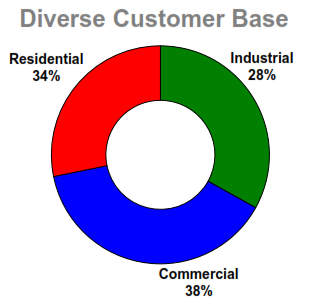
In March 2015, Westar requested approval from the Kansas Corporation Commission to increase the rates it charges by 7.9% or $152 million to recover Environmental Protection Agency (EPS) costs as well as increased service reliability. And in August they reached an agreement for a $78 million rate increase. The approved rate increase demonstrates the region’s support for Westar Energy.
Valuation:
We value Westar at $46.48 per share by discounting its $2.44 expected 2015 earnings per share using a required rate of return of 6% (weighted average cost of capital) and a growth rate of only 0.75% per year which is the long-term rate Westar expects (annual report p.28). If the growth rate ends up being higher than 0.75% then the stock is worth even more. Our $46.48 price target gives the stock more than 16% upside, with potential for further increases depending on the company’s future growth and profitability.
Dividends:
In addition to potential gains via capital appreciation, Westar offers shareholders an increasing dividend. Dividends are common for stable utility companies like Westar, and in this case Westar offers and attractive 3.62% dividend yield. And the amount of Westar’s dividend payments has increased over time (see graph below), and the company expects this trend to continue.

Conclusion:
Westar is a diversified electric utility company that rewards shareholders with a growing dividend and opportunity for capital appreciation. Additionally, this electric utility company investment adds important sector diversification to our Blue Harbinger 15 portfolio. It is important to invest across a variety of market sectors (e.g. utilities, consumer discretionary, technology, etc.) to reduce exposure to sector specific risks and to minimize overall volatility in the value of your investment portfolio.
Looking to Put Money to Work?
Large Value ETF (IWD) Update – Great Time to Own Value
It was a great week for our large cap value ETF (IWD), as it gained 4.0%. Value stocks (such as the ones in our ETF) have a long history of outperforming growth stocks over the long term (e.g. 10+ year periods). And now is a great time to own value stocks given that they have been underperforming growth in recent years. Said differently, now is a great time to buy low.
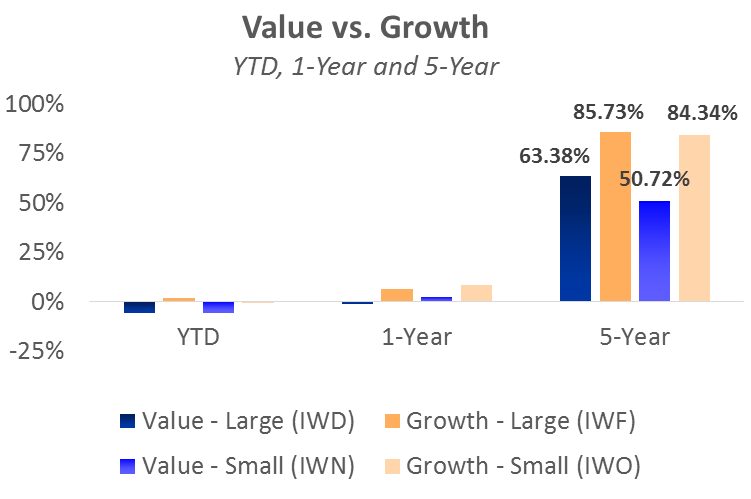
Growth stocks have performed well over the most recent market cycle because of the accommodative monetary policies in the US. With the fed setting interest rates so low, it’s been easier for risky growth companies to borrow money to fuel cheap growth. However, it will be bad news for growth stocks when the fed eventually starts to raise interest rates as they are widely expected to do within the next several months. It’s unusual for growth stocks to outperform value for as long as they have (see the chart above) but when it does happen it usually ends badly for growth stocks. For example, it ended very badly for growth stocks when the tech bubble burst in the early 2000’s. As contrarian investors, we believe now is a great time to own value stocks such as the ones in our large cap value ETF (IWD).