
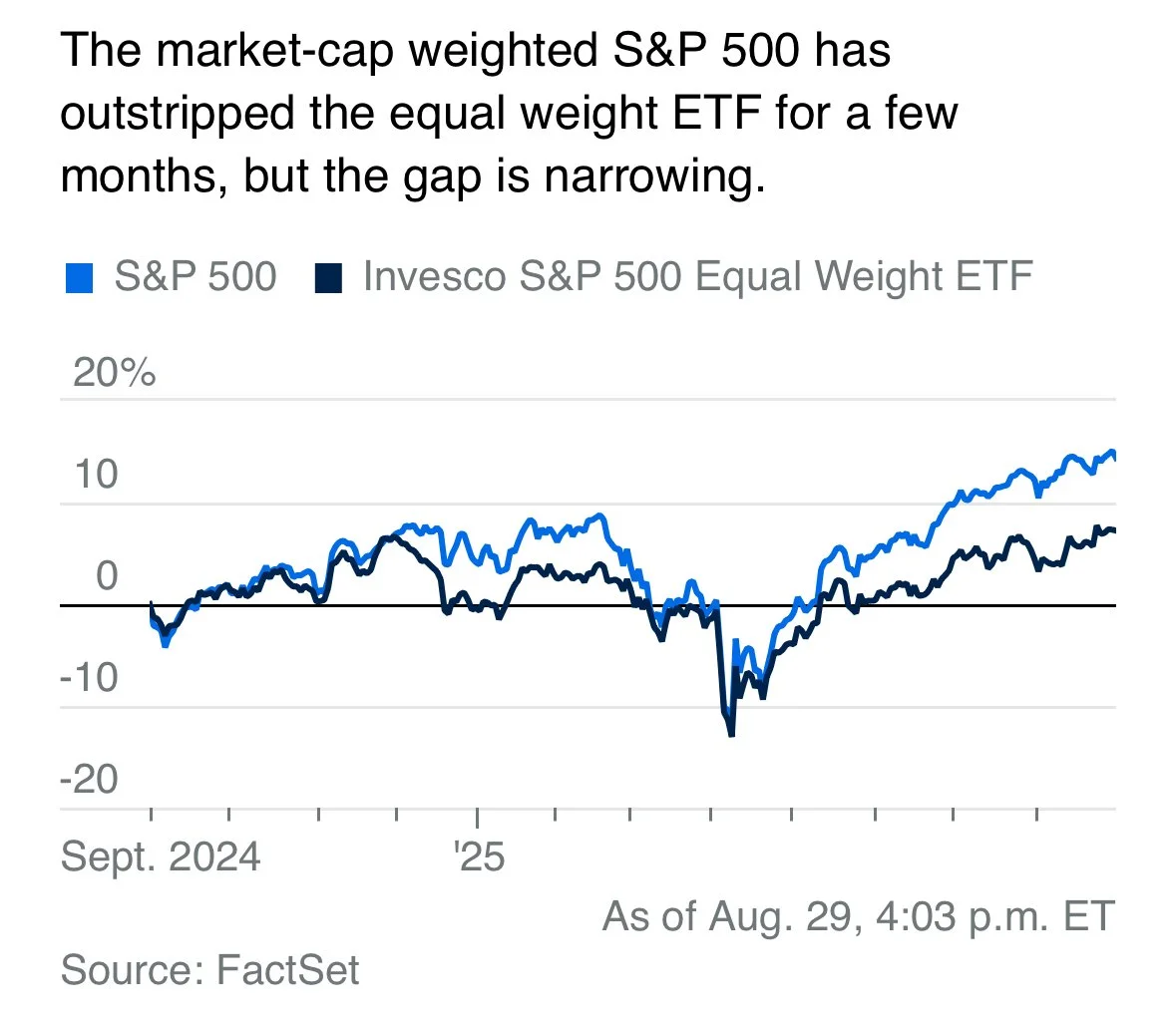
Market styles can ebb and flow, but it’s still underlying fundamentals that ultimately drive business and economic growth. Big tech and the “Mag 7” have dominated in recent months (and years) and they are absolutely not going away. But, if you are looking for some non-mega-cap stock ideas, that will also benefit from the biggest secular trend (call it a mega-trend) in many years (i.e. the cloud and artificial intelligence), here are 10 top non-mega cap names (explained and ranked, with current attractive value propositions highlighted), especially as the megacaps may be about to give back a little, relatively speaking, in that ongoing “ebb and flow” cycle (as you can see in the chart below).
So with that backdrop in mind, let’s get right into the ranking and countdown.
10. Bloom Energy (BE):
Bloom Energy manufactures solid oxide fuel cells for distributed power generation, including for AI data centers seeking reliable energy. Its 19% sales growth next year and focus on alternative power solutions offer exposure to the AI ecosystem. Bloom Energy's partnerships with Oracle, Equinix, and AEP for SOFC deployments address AI data centers' need for on-site, low-carbon power, with projections of 38% on-site generation by 2030. Bloom’s price/sales of 7.5x is actually quite reasonable as compared to the market opportunity for clean energy adoption.
You can view my full report on Bloom Energy here.
9. IREN (IREN):
Also known as Iris Energy, IREN operates data centers originally for bitcoin mining but is now pivoting to high-performance computing for AI workloads. Its 165% current sales growth and 88.2% next-year projection, combined with a low 1.46 consensus rating (“Strong Buy” from Wall Street), make it compelling for AI data center exposure. Iris Energy's procurement of 2.4k Nvidia Blackwell GPUs, bringing its total to 4.3k, positions it to capture growing AI compute demand with fully funded expansions. With a forward P/E of 15x and price/sales of 14x, IREN offers an attractive entry point for growth-oriented investors amid its AI pivot.
8. Nebius Group (NBIS):
Nebius Group is a Europe-based technology company providing AI infrastructure, cloud services, and advanced AI applications including self-driving tech. It’s highly attractive with a staggering 383% current-year sales growth and over 100% projected for next year, plus a focus on global AI builders. Nebius's 625% Q2 revenue growth and plans for over 1GW power capacity by 2026 highlight its ability to outperform traditional cloud giants through AI-specific vertical integration. Trading at a trailing P/S of 65x, Nebius appears expensive but justified by its explosive growth trajectory in the AI sector.
7. Astera Labs (ALAB):
Astera Labs develops connectivity solutions and semiconductors that enable high-speed data transfer in AI systems and data centers. Its 96% current sales growth and 30.8% next-year forecast, alongside a strong 1.47 consensus rating (“Strong Buy” from Wall Street), make it attractive for AI’s need for advanced chip interconnects. Astera's PCIe 6.0 retimer and Scorpio-P PCIe Smart Fabric Switch demonstrate end-to-end interoperability with Nvidia's Blackwell GPU, minimizing risks in rack-scale AI deployments. At a forward P/E of over 90x, Astera commands a high valuation driven by its niche in AI connectivity, but considering its long-term megatrend potential, it’s more reasonably-priced than meets the eye.
You can view my full report on Astera Labs here.
6. CoreWeave (CRWV):
CoreWeave is a specialized cloud computing provider focused on delivering high-performance GPU infrastructure for AI and machine learning workloads. It’s an attractive investment due to its projected 128.1% sales growth next year and acquisition of Core Scientific, positioning it at the forefront of the AI infrastructure boom. CoreWeave's $23 billion investment plan and $30.1 billion revenue backlog, bolstered by Nvidia’s 5% ownership granting early access to Blackwell GPUs, underscore its potential to dominate the AI cloud market amid GPU shortages. At a current price/sales ratio of 14.2x and EV/EBITDA of 37x, CoreWeave trades at a premium reflecting its hyper-growth phase, yet offers value for AI-focused investors betting on sustained demand.
5. Constellation Energy (CEG):
Constellation Energy is a leading producer of clean nuclear energy, supplying power to AI data centers. Its 20.4% upside to targets (as per Wall Street analysts) and its role as the largest U.S. nuclear operator, make it appealing amid AI’s soaring energy demands. Constellation's $26.6 billion acquisition of Calpine creates the nation's largest clean energy company, expanding its footprint into AI-heavy Texas and California markets. With a forward P/E of 28x and price/sales of 3.9x, CEG's valuation is robust compared to utilities peers but compelling considering its AI energy tailwinds.
4. Vistra (VST):
Vistra is an integrated power company generating electricity from diverse sources to meet AI data center demands. With 18% current year sales growth and a low 1.40 consensus rating (“Strong Buy” from Wall Street), its diversified portfolio positions it for stable returns in the AI energy race. Vistra's $3.2 billion acquisition of additional equity in Vistra Vision LLC strengthens its nuclear assets, aligning with AI's need for reliable, low-emission baseload power. At a forward P/E of 22x and price/sales of 3.5x, Vistra trades at a reasonable multiple considering its growth.
3. Vertiv Holdings (VRT):
Vertiv Holdings provides critical power, cooling, and IT infrastructure solutions for data centers supporting AI operations. With 25% current year sales growth and a 20.5% upside to consensus targets, it’s a solid pick as AI expansion drives demand for efficient thermal management. Vertiv's innovations in liquid- and air-cooling strategies are crucial for handling AI rack densities reaching 500-1000kW, addressing the industry's shift toward complex cooling solutions. Trading at a forward P/E of 26x and price/sales of 5.4x, Vertiv's valuation reflects strong growth prospects and is very compellig given its forward PEG ratio of 0.98x (attractive!).
2. Super Micro Computer (SMCI):
Super Micro Computer designs and manufactures high-performance servers and storage systems optimized for AI and data center applications. With 45% current year sales growth and a low P/S ratio of 1.2, it’s appealing due to its Nvidia partnerships and essential role in scaling AI compute. Super Micro's shipment of over 100,000 GPUs per quarter and new liquid cooling products offering up to 40% energy savings position it as a key enabler for large-scale AI deployments. Its forward P/E of 16.81 and price/sales of 1.26 suggest undervaluation relative to peers, making it a value play in AI hardware.
1. Innodata (INOD):
Innodata provides data engineering, annotation, and transformation services essential for training AI models. With 45% current year sales growth and a massive 75.7% upside to consensus Wall Street targets, it’s an under-the-radar play on AI’s data preparation needs. Innodata's Q2 2025 revenue of $58.4 million, up 79% YoY, and contracts with five Magnificent Seven tech giants position it as a critical supplier in the $1.36 trillion generative AI market by 2032. Trading at a forward P/E of 31x and price/sales of 5.6x, Innodata offers compelling value relative to its growth, making it highly attractive for its AI data service exposure.
You can view my full report on Innodata here.
The Bottom Line:
Investing in the AI megatrend is not for everyone, and frankly it’s probably not a good idea for anyone to “bet the farm” on AI and nothing else. However, it is an important marketwide theme that will likely drive economic growth for many years to come. And considering the “Mag 7” megacap names (Microsoft, Nvidia, Meta, et al) have been so dominant, investing a few non-mega-cap ideas (such as those highlighted in this report) can make a lot of sense for a lot of people.
At the very least, hopefully you are able to identify a few top ideas in this report for further consideration. You can view all the holdings in my prudently-concentrated, long-term “Disciplined Growth Portfolio” here.